

Shame vs Guilt: The Distinction Most Men Never Learn
Take your car to a mechanic and he tells you the alternator is failing. That is useful. You know what is broken, roughly what it costs, and what happens next.
Take it to a different mechanic and he says the car is junk. Possibly also true. Completely useless.
Guilt is the first diagnosis. Shame is the second. Most men, when something goes wrong, run the second one on themselves and then wonder why nothing improves.
The shame vs guilt question gets treated as a matter of wording, which is unfortunate, because psychologists have spent fifty years establishing that these are different emotions with opposite consequences. One of them drives repair. The other drives hiding. They feel nearly identical from the inside.
This is the distinction, what the research actually found, the complication most articles leave out, and why men in particular tend to end up with the version that helps least.
Shame vs Guilt: The Distinction Almost Nobody Makes
The psychoanalyst Helen Block Lewis set this out properly in 1971, and it has held up remarkably well since.
Guilt is a negative evaluation of a specific behavior. I said something unkind. I let him down. I should have handled that better. The self stays intact. The action is what is under review, and the action is a thing you can do something about.
Shame is a negative evaluation of the entire self. The sentence shifts from I did something bad to I am bad. The mistake stops being an isolated event and becomes evidence of a fundamental defect that was always there and has now been exposed.
That shift changes what you do next, and it changes it completely.
Guilt produces an urge toward repair. Apologize, fix it, do better. The emotion points outward at the damage and at the person affected.
Shame produces an urge to disappear. Withdraw, hide, avoid the person who saw it, get out of the room. Researchers describe the characteristic action tendency as wanting to sink into the floor. The emotion points inward at the self, and a defective self cannot be repaired by apologizing.
Same event. One word different in the sentence. Opposite behavior.
What the Research Actually Found
The most useful single source on this is a 2011 meta-analysis published in Psychological Bulletin, which pooled 242 effect sizes from 108 studies covering 22,411 participants.
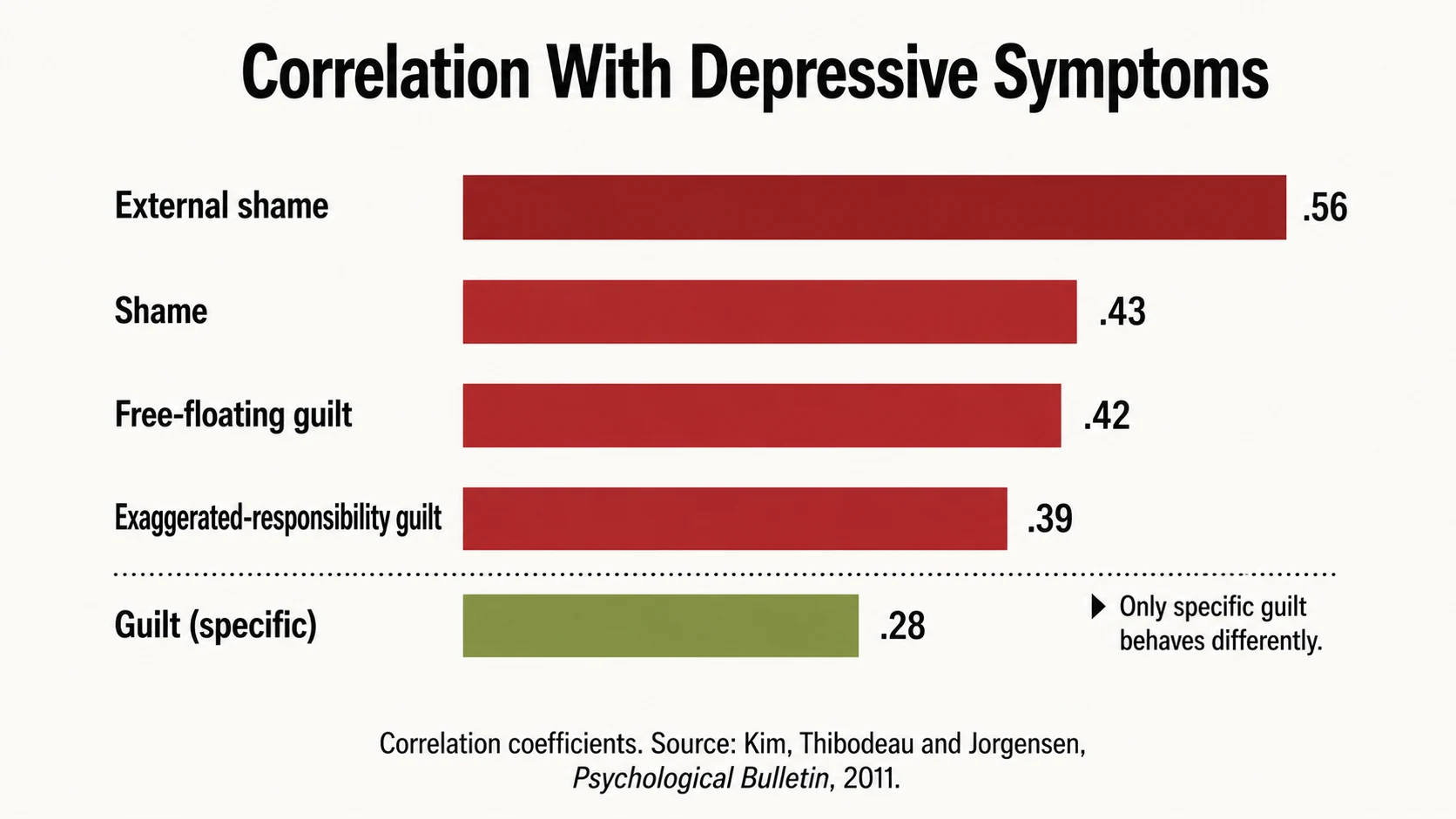
Shame showed a substantially stronger association with depressive symptoms than guilt did. The correlation for shame was .43. For guilt it was .28.
The same analysis produced a second finding that matters more for men than it usually gets credit for. Researchers distinguish between external shame, meaning a negative view of yourself as you believe others see you, and internal shame, meaning a negative view of yourself in your own eyes.
External shame was associated with considerably larger effects. The correlation was .56, against .42 for internal shame.
Shame about being seen failing is more strongly linked to depression than shame about failing. Sit with that for a moment if you have ever cared more about being found out than about the thing itself.
Work by June Tangney and Ronda Dearing across two decades points the same direction from a different angle. Guilt-proneness, meaning the tendency to respond to wrongdoing with focused guilt, tracks with empathy, taking responsibility, apologizing, and making repair. Shame-proneness tracks with withdrawal, defensiveness, blaming others, and anger.
Their most striking result came from following jail inmates over time and published in Psychological Science in 2014. Shame-proneness, particularly when combined with a tendency to blame others, predicted higher rates of reoffending. Guilt-proneness predicted the opposite.
The widespread assumption is that feeling badly enough about yourself will motivate you to be better. Fifty years of data suggest close to the reverse.
The Complication Everyone Skips
Here is where most articles on this topic stop, and where the useful part actually begins.
The standard advice that follows from the shame and guilt distinction is: convert your shame into guilt. Change I am a failure to I failed at that, and you will get the useful emotion instead of the destructive one.
The same meta-analysis found that this depends entirely on what kind of guilt you land in.
Two variants of guilt performed no better than shame. The first was generalized guilt, described in the research as free-floating guilt that is not attached to any specific context, with a correlation of .42. The second was what researchers call contextual-maladaptive guilt, meaning exaggerated responsibility for events you could not control, at .39.
Compare those to shame at .43. They are statistically indistinguishable.
So the simple version, guilt good and shame bad, is not quite what the data says. What separates the useful emotion from the useless ones has nothing to do with the label. It comes down to whether the feeling is attached to a specific act you could actually have done differently.
A man who tells himself I am a bad father is in shame. A man who tells himself I feel guilty all the time about my kids has swapped the word without changing anything, because free-floating guilt about an entire domain of life is just as unhelpful. A man who tells himself I was on my phone during dinner again and my son noticed has something he can act on tonight.
The test has little to do with which word you use. It comes down to whether the sentence points at a behavior with a next step attached.
Why Men End Up With the Useless One
Nothing in the research says men feel more shame than women. What the structure of the findings suggests is that men are unusually exposed to the worst-performing variety of it.
External shame, the version associated with the largest effect sizes, is shame about how you appear to others. Most of what men are taught to measure themselves by is external and visible: income, job title, physical capability, whether you provide, whether you are seen to be coping.
A man who loses a job has a practical problem. A man who believes other men can see that he lost his job and are drawing conclusions about him has external shame, and external shame is the variant most closely tied to depression.
The second structural problem is that shame drives hiding, and hiding is exactly what makes shame worse. The emotion produces an urge to withdraw from the people whose opinion triggered it. Withdrawal then removes the only thing that reliably reduces shame, which is saying the thing out loud to someone who does not recoil.
Men are already less likely to seek help, less likely to name what they are feeling, and more likely to interpret needing help as further evidence of the defect. The emotion and the cultural script reinforce each other neatly.
This is part of why external success so often fails to resolve anything. A man can clear every visible checkbox and still be running the same internal verdict, which is the pattern explored in why men feel empty even after success.
Humiliated Fury
Helen Block Lewis gave a name to something worth recognizing, because it explains a great deal of male behavior that otherwise looks like a temper problem.
She called it humiliated fury: the way shame converts into rage directed at whoever seems to be exposing it.
The mechanism makes sense once you see it. Shame is an unbearable feeling of being small and defective. Anger is a feeling of being large and powerful. When the first becomes intolerable, the second is available immediately, and it points outward instead of inward. It is the fastest exit from the room.
This is why a man who is gently criticized sometimes responds as though he has been attacked. Why feedback at work can produce a disproportionate reaction. Why a partner pointing out something small can trigger a fight about something else entirely.
The anger is rarely the real emotion. It is the escape hatch from the one underneath it.
Recognizing this while it is happening is difficult and worth practicing. A reaction that seems out of proportion to the trigger is usually a signal that something landed on the self rather than on the behavior.
How to Tell Which One You Are In
Three questions separate them reasonably well in the moment.
What is the sentence? Write down the thought without editing it. If it contains the word am, you are probably in shame. I am useless. I am a disappointment. I am not the man I should be. If it contains a verb describing an action, you are closer to guilt. I forgot. I snapped at her. I did not follow through.
What does it make you want to do? Guilt makes you want to go and fix something. Shame makes you want to leave, cancel, avoid the person, or stop answering messages. If the impulse is to disappear rather than to repair, that is the tell.
Is there a next step? This is the one that catches maladaptive guilt as well. If the honest answer to “what would I do about this tomorrow” is nothing, then whatever you are feeling is not doing useful work, regardless of which word you attached to it.
That third question is the practical core of everything above. A feeling with a next step attached is functional. A feeling without one is just weather.
What Actually Changes It
Say it out loud to one person. Shame runs on concealment. The reliable finding across the clinical literature is that shame loses force when it is spoken to someone who responds without recoiling. This does not require a therapist, though it can. It requires one person who will hear the sentence without flinching. Most men do not have one, and building that is worth more than any technique.
Convert the sentence, and check the conversion. Move from I am to I did. Then apply the third question. If the new sentence still has no action attached, you have moved from shame to free-floating guilt, which the research says buys you nothing.
Separate what you controlled from what you did not. Exaggerated responsibility for uncontrollable events performed as badly as shame in the data. If the situation involved a downturn, someone else’s decision, or plain bad luck, the accurate accounting is part of the work rather than a way of letting yourself off.
Do the repair, then stop. Guilt is meant to be a signal that terminates when the signal has been acted on. Apologize, fix what can be fixed, and then let it end. Guilt that continues after repair has quietly become something else.
Notice the anger. When a reaction seems too large for the trigger, treat it as information rather than as a character flaw. That mental loop is worth understanding on its own, which is covered in how to stop overthinking and take action.
Build evidence rather than arguments. You do not talk yourself out of believing you are a failure. You accumulate a record of doing what you said you would do until the belief has to compete with the evidence. That mechanism is the same one behind how confidence actually gets built.
When This Is More Than an Emotion
Everything above describes ordinary shame, which everyone experiences and which passes.
Persistent shame is a different situation. Shame with a correlation of .43 to depressive symptoms describes a clinically meaningful relationship rather than a philosophical curiosity. Shame that does not lift, that attaches to your whole life rather than to specific events, or that comes with loss of interest, hopelessness, or thoughts of not being here, warrants professional attention rather than a self-help strategy.
Men are statistically less likely to seek that help and more likely to be diagnosed late. The same emotion this article is about is a significant part of why.
Speaking with a qualified mental health professional is a practical step, and treating it as a last resort rather than a normal option is the pattern worth breaking. If you are in immediate distress, contact a crisis line or emergency service in your country. Support exists, and using it is not evidence of anything except that you noticed something and acted on it.
The Short Version
Shame says the car is junk. Guilt says the alternator is failing. Only one of those tells you what to do on Monday.
The research is unusually consistent for this field. Shame tracks with depression, withdrawal, defensiveness, and anger. Guilt tracks with empathy, repair, and taking responsibility. Feeling worse about yourself has never been shown to make you better.
And the refinement worth keeping: swapping the word achieves nothing on its own. Free-floating guilt performs about as badly as shame. What separates a useful feeling from a useless one is whether it points at a specific thing you could have done differently, and whether there is a next step attached.
So when something goes wrong, notice which diagnosis you just ran on yourself. Then ask what you would do about it tomorrow.
If there is an answer, get on with it. If there is not, you are not being accountable. You are just sitting in the wrong emotion.
References
- Kim S, Thibodeau R, Jorgensen RS. Shame, guilt, and depressive symptoms: A meta-analytic review. Psychological Bulletin. 2011;137(1):68-96.
- Tangney JP, Dearing RL. Shame and Guilt. Guilford Press; 2002.
- Tangney JP, Stuewig J, Martinez AG. Two faces of shame: The roles of shame and guilt in predicting recidivism. Psychological Science. 2014;25(3):799-805.
- Lewis HB. Shame and Guilt in Neurosis. International Universities Press; 1971.
- Tangney JP, Stuewig J, Mashek DJ. Moral emotions and moral behavior. Annual Review of Psychology. 2007;58:345-372.
- National Institute of Mental Health. Men and Mental Health.
FAQ
Q1. What is the difference between shame and guilt?
Guilt is a negative evaluation of a specific behavior, expressed as “I did something bad.” Shame is a negative evaluation of the entire self, expressed as “I am bad.” Guilt tends to produce an urge to repair the damage. Shame tends to produce an urge to withdraw and hide.
Q2. Is shame worse than guilt?
On the available evidence, yes. A 2011 meta-analysis pooling 108 studies and 22,411 participants found shame correlated with depressive symptoms at .43 compared with .28 for guilt. Shame-proneness also tracks with withdrawal, defensiveness, and anger, while guilt-proneness tracks with empathy and taking responsibility.
Q3. Can you just convert shame into guilt?
Only if the new sentence points at something specific. The same meta-analysis found that free-floating guilt not attached to a context correlated at .42 and exaggerated responsibility for uncontrollable events at .39, which is statistically indistinguishable from shame. Changing the word without changing the specificity achieves nothing.
Q4. Why does shame make men angry?
Helen Block Lewis called this humiliated fury. Shame is a feeling of being small and defective, while anger is a feeling of being large and powerful, and anger points outward rather than inward. When shame becomes intolerable, anger is the fastest available exit, which is why a small criticism can produce a disproportionate reaction.
Q5. Why is external shame worse than internal shame?
External shame is a negative view of yourself as you believe others see you, and it showed a correlation of .56 with depressive symptoms compared with .42 for internal shame. Much of what men are taught to measure themselves by is externally visible, which places them heavily in the more damaging category.
Q6. How do you reduce shame?
Shame runs on concealment and loses force when spoken to someone who responds without recoiling. Beyond that, converting the sentence from “I am” to “I did,” separating what you controlled from what you did not, completing the repair and then stopping, and building a record of follow-through all help.
Q7. When should shame be treated as a mental health issue?
When it persists rather than passing, attaches to your whole life rather than to specific events, or comes alongside loss of interest, hopelessness, or thoughts of not being here. Shame has a clinically meaningful relationship with depression, and speaking with a qualified mental health professional is a reasonable and practical step.
Medical disclaimer: This article is for educational purposes only and is not medical advice, diagnosis, or treatment. Individual results vary. Always consult a qualified physician about your own health, especially before starting a new exercise program, changing your diet, or taking any supplement.