
Tired After 8 Hours of Sleep (It’s Not the Hours)
If you’re tired after 8 hours of sleep, you’re not alone. In bed by eleven. Alarm off at seven. Eight clean hours, the exact number every headline tells you to hit. And still, standing at the coffee machine at quarter past seven, you feel foggy and heavy, already dreading the nine o’clock meeting. Three or four mornings a week, same story.
The uncomfortable part is that the hours were never the problem. You’ve been tracking a number that doesn’t measure the thing you actually care about.
Sleep doesn’t work like a battery that fills up minute by minute. Eight hours in bed and eight hours of real recovery are two different things, and the space between them is where most exhausted men are stuck. You can spend a whole night under the covers and still miss the parts that repair you. The clock says you slept, but your body tells a different story.
What Happens During Deep Sleep and REM
Sleep runs in cycles of roughly ninety minutes, and each cycle moves you through distinct stages: light sleep, deep sleep (the slow-wave kind), and REM, where the eyes flicker and dreaming happens. The overall shape of a night, including the depth and balance of those stages, is your sleep architecture. Two men can both log eight hours and wake up feeling like they inhabit different bodies, purely because of how their stages were arranged.
Of those stages, deep sleep and REM handle most of the repair work.
Deep sleep handles most of the body’s physical recovery. During slow-wave sleep your body releases the bulk of its daily growth hormone, the raw material for rebuilding muscle and tissue. Blood pressure drops. The brain runs its cleanup crew, flushing out metabolic waste that accumulates over the day. Shortchange deep sleep and you wake up physically wrecked, like you did a workout you can’t remember.
REM handles the mind. It’s when the brain files emotional memories, links ideas, and resets you for the day. Cut REM short and you get the other flavor of tired: mentally foggy, short-fused, groping for a word that won’t come.
Now the detail that should change how you think about your whole night. Deep sleep is front-loaded. Your first two cycles hold the most of it, often forty to fifty minutes packed into the first half of the night. By the fourth and fifth cycles it nearly disappears and REM takes over. So the first few hours after you fall asleep are the most valuable of the entire night. Anything that damages those early hours robs you of the exact sleep meant to rebuild you, even if you stay in bed the full eight.
For a sense of what a healthy night looks like, Cleveland Clinic breaks a typical adult night into roughly 5 percent Stage 1, 45 percent Stage 2 light sleep, 25 percent deep sleep, and 25 percent REM. The CDC’s guidance is simpler and covers only the total: at least seven hours a night for adults.
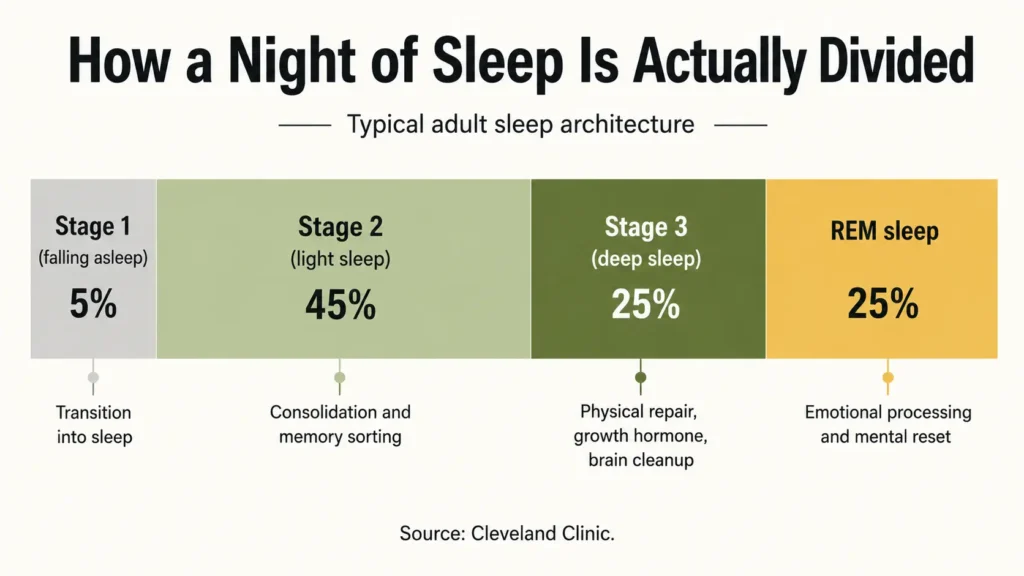
So the real question was never “did I get eight hours.” It’s whether you got your ninety minutes of deep sleep and your full run of REM. You can nail the first and completely miss the second.
Four Things That Ruin Your Sleep Quality
Most tired men don’t have a shortage of time in bed. They have a quality problem, and quality problems are invisible on the surface, which is exactly why they’re maddening. You’re doing what everyone told you to do, and it isn’t working.
Four culprits do most of the damage. None of them stop you from sleeping. They stop you from sleeping well.
Start with the nightcap, because this one stings. A drink makes you drowsy, you fall asleep faster, and it feels like a win. But alcohol suppresses your body’s recovery in the exact first hours of the night when it matters most. A 2018 study in JMIR Mental Health tracked 4,098 Finnish employees with chest-worn heart monitors and measured physiological recovery during the first three hours of sleep. Even a single drink measurably suppressed it. Around three drinks cut recovery by 24 percentage units. For an 80-kg man, five drinks meant roughly 45 minutes less recovery in those first three hours. And being fit was no protection: the effect was just as strong in physically active men as in sedentary ones. You slept. You just didn’trecover.
Then there’s a bedroom that runs too warm. Your core temperature has to fall a degree or two to trigger and hold deep sleep, and a hot room fights that all night. The Sleep Foundation and Cleveland Clinic both land in the same place: somewhere around 65°F, roughly 18 Celsius, with trouble starting once a room sits above 70 overnight. The frustrating bit is that heat breaks up deep sleep even when you never fully wake. You sleep seven or eight hours and still feel like nothing landed.
Third is the phone you scroll until your eyes close on their own. Blue light plus the low hum of stimulation pushes back your wind-down and shaves time off deep sleep. It feels like relaxing. Your nervous system reads it as a reason to stay switched on.
And last, a mind that won’t stop running. Stress and anxiety keep cortisol elevated overnight, and elevated cortisol pins you in light sleep. You can be physically drained and mentally wired at the same time: the body wants to go under, but the brain won’t let it. The result is waking up tired, tense, and foggy after a full eight hours in bed.
Notice what all four have in common. Every one lets you fall asleep and stay there. That’s the catch. They pass the only test most people run: Was I asleep?, while failing the one that decides how you feel.
How to Fix Poor Sleep Quality

You don’t need more time in bed. You need to defend the quality of the time you’re already spending.
Drop your bedroom into the mid-60s Fahrenheit. If that feels like a lot tonight, don’t shock yourself. take it down a degree every few days until you get there, then leave it. A warm shower before bed helps in a roundabout way, because the rebound cooling once you step out nudges your core temperature down.
Move your last drink well back from bedtime, ideally a few hours, so the deep-sleep window in the first half of the night stays clean. This isn’t a lecture about quitting. It’s about not drinking right before the part of sleep you can least afford to lose.
Get the phone out of the final stretch of the night. Not “use it less.” physically end screen time before you’re in bed, so your nervous system has room to come down.
Keep your bedtime and wake time boring and identical, weekends included. Your architecture runs on rhythm; scramble the timing and you scramble the whole night. Irregular sleep throws off the circadian rhythm that schedules your deep and REM stages in the first place.
And deal with the racing mind before it deals with you. A few minutes of slow nasal breathing, or dumping tomorrow’s worries onto paper, pulls cortisol down before your head hits the pillow and protects the deep sleep that stress otherwise steals.
Give it two weeks. Not one good night, two consistent weeks. Sleep architecture answers to patterns, not one-offs.
When Fatigue Means Something Medical
Sometimes you fix the room, kill the nightcap, ditch the phone, calm the mind, and you’re still running on empty. That’s worth taking seriously, because some causes of broken sleep sit underneath your habits where no thermostat will reach. Sleep apnea, thyroid problems, low iron, and hormonal shifts all fragment deep and REM sleep from below. If loud snoring, gasping in your sleep, or waking with headaches sounds familiar, that’s a doctor’s appointment, not a lifestyle tweak. Fatigue that won’t lift no matter what you change is a signal worth having a professional read.
The thing to remember
Stop asking your phone how long you slept. Start asking your body how well. Eight hours was never the finish line. It was a number that let you feel like you’d tried.
Real rest doesn’t show up on a clock. It shows up in whether the machine underneath actually got to do its work. You’ve been counting the hours. Tonight, guard them.
References
References
Cleveland Clinic. Sleep: What It Is, Why It’s Important, Stages, REM and NREM.
Centers for Disease Control and Prevention (CDC). About Sleep.
National Institute of Neurological Disorders and Stroke (NINDS). Brain Basics:
Understanding Sleep.
Sleep Foundation. Stages of Sleep: Deep Sleep.
FAQ
Why am I tired after 8 hours of sleep?
Feeling tired after 8 hours of sleep is often linked to poor sleep quality rather than sleep duration. Interrupted deep sleep, reduced REM sleep, stress, alcohol, sleep apnea, or other health conditions can all leave you feeling exhausted despite spending enough time in bed.
Can you sleep 8 hours and still be tired?
Yes. Eight hours in bed does not always mean eight hours of restorative sleep. If your deep sleep or REM sleep is disrupted, you may wake up feeling physically and mentally drained.
Does deep sleep matter more than total sleep time?
Both matter, but deep sleep plays a major role in physical recovery, while REM sleep supports memory, learning, and emotional regulation. A full night’s sleep should include healthy amounts of both stages.
Why do I wake up tired every morning?
Common reasons include poor sleep quality, stress, alcohol before bed, an overly warm bedroom, excessive screen time at night, inconsistent sleep schedules, or underlying medical conditions such as sleep apnea or thyroid disorders.
When should I see a doctor for constant fatigue after sleeping?
If you regularly wake up tired despite getting enough sleep, especially if you snore loudly, gasp during sleep, wake with headaches, or experience persistent daytime fatigue, it’s a good idea to consult a healthcare professional to rule out conditions such as sleep apnea, thyroid problems, iron deficiency, or other sleep disorders.
Medical disclaimer: This article is for educational purposes only and is not medical advice, diagnosis, or treatment. Individual results vary. Always consult a qualified physician about your own health, especially before starting a new exercise program, changing your diet, or taking any supplement.