

VO2 Max: The One Number That Predicts How Long You’ll Live
Your doctor tracks your cholesterol. Your blood pressure. Maybe your blood sugar. All useful. But there’s a single fitness number that beats every one of them at predicting when you’ll die, and almost nobody in a standard checkup ever mentions it.
It’s called VO2 max, and the research on it is not subtle.
And there’s no ceiling. That same analysis found extreme fitness, defined as
two standard deviations above the age and sex average, carried the lowest
mortality of any group, with no point where being fitter stopped helping. The
old worry that you could overdo cardio and somehow age faster didn’t show up
in the data. Fitter was better, all the way up.
So what is this number, and why does it carry so much weight?
VO2 max is the maximum amount of oxygen your body can pull in and actually use during all-out effort, measured in milliliters of oxygen per kilogram of bodyweight per minute. That sounds like a lab stat, but here’s why it matters more than any blood test: it’s a live readout of how well your heart, lungs, blood vessels, and muscles work together under load. No single blood panel captures all four systems at once. VO2 max does. When it’s high, all of that machinery is running clean. When it’s low, something in the chain is failing, and your body is telling you years in advance.
What the VO2 Max Mortality Research Actually Says
The relationship is close to linear, which is unusual and important. It’s not that you have to become an elite athlete to benefit. Every step up the fitness ladder buys you something measurable.
The most cited number comes from a large JAMA analysis: every one-MET increase in fitness roughly 3.5 ml/kg/min of VO2 max is tied to a 13 to 15 percent drop in all-cause mortality. One MET. That’s the difference between a slow walk and a brisk one, held over months. Push further up the scale and men in the highest fitness bracket have shown something like five extra years of life expectancy compared to the lowest.
And there’s no ceiling. A JAMA Network Open study looking at extreme fitness found the fittest people had the lowest mortality on record, with no point where being fitter stopped helping. The old worry that you could overdo cardio and somehow age faster didn’t show up in the data. Fitter was better, all the way up.
Here’s the part that should get you off the couch, though. The biggest payoff isn’t at the top. It’s at the bottom. That same Cleveland Clinic dataset found the largest single drop in death risk came from moving out of the lowest fitness group into merely below-average. In plain terms: if you’re badly out of shape right now, you have the most to gain from anyone reading this. The first few weeks of training move the needle harder than years of tinkering at the elite end ever could.
What Is a Good VO2 Max for Your Age?
VO2 max isn’t one universal target. It shifts with age and sex, and it naturally slides by around 10 percent each decade after 30 if you do nothing about it. That decline is the default. It’s also largely optional.
The goal isn’t to hit some number off a chart. It’s to be clearly above average for your age, and then to hold that line as the years pass instead of letting the decade-by-decade slide take it. Here is roughly where the ranges fall.
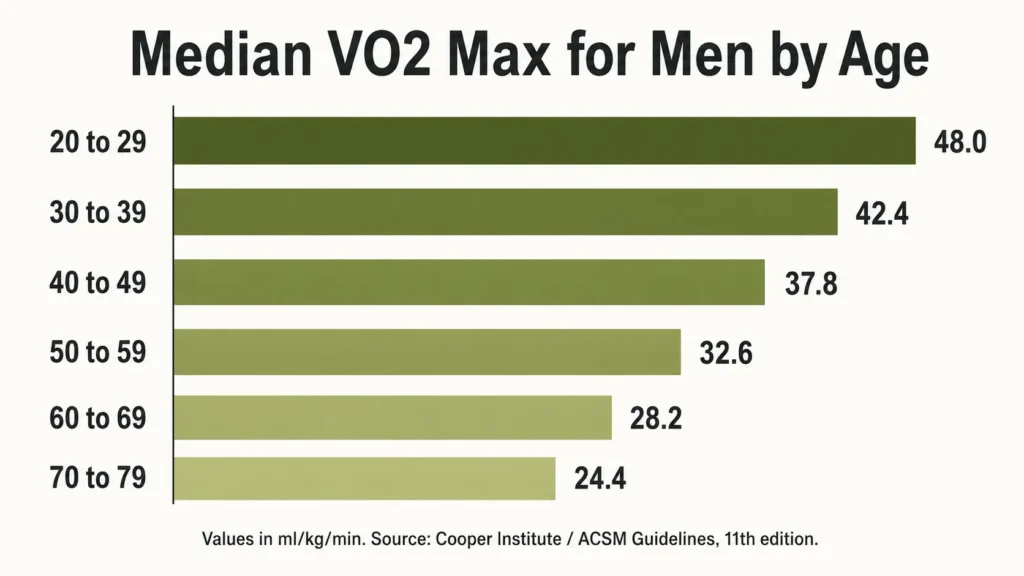
training. The goal is to sit clearly above the median for your age and hold
that line.
You can get a lab test for the precise figure. But most people don’t need clinical precision to start. An Apple Watch or Garmin will give you an estimate that trends in the right direction, and the trend is what you’re managing. Consistent improvement or maintenance matters far more than any single reading.
How to Increase Your VO2 Max

Two kinds of training raise VO2 max, and the mistake most people make is doing only one of them, usually the easy one.
The foundation is easy aerobic work, specifically Zone 2, the pace where you can still hold a conversation but wouldn’t want to sing. This builds the plumbing: more capillaries, better fat-burning, a bigger aerobic base. Roughly 80 percent of your weekly cardio should live here. It feels almost too easy, which is exactly why people skip it or unconsciously push it too hard. Zone 2 on its own, though, won’t lift your ceiling much. It builds the engine block; it doesn’t raise the redline.
To lift the ceiling, you need intervals near your max, and the best-studied tool for this has a name: the Norwegian 4×4.
The structure is simple. After a warm-up, go four minutes hard, around 90 to 95 percent of your max heart rate, hard enough that you can only get a word or two out, not a sentence. Then three minutes of easy recovery. Repeat four times. That’s it. Four rounds of four minutes.
Those four-minute efforts are the point. They’re long enough to hold your heart near maximal output, which is what drives the adaptation because your heart literally learns to pump more blood per beat. When Norwegian researchers led by Jan Helgerud tested this, eight weeks of 4×4 intervals produced a 13 percent jump in VO2 max, compared with barely 3 percent from steady-state jogging over the same period. Same time invested, four times the result.
You don’t need a track or fancy gear. It works on a bike, a rower, a treadmill with the incline up, or a hard hill. What you do need is a way to gauge intensity: a heart rate monitor, or at minimum the talk test. If you can chat comfortably during the hard minutes, you’re not there yet. If your form falls apart in round four, you went out too hot.
A workable week for most men: two 4×4 sessions and two to three easy Zone 2 sessions. Build a base first, though. if you can’t jog thirty minutes at an easy conversational pace without your heart rate drifting up, spend a few weeks there before touching the intervals. Jumping straight into 4×4 without a base produces failed workouts, not fitness.
Give it six to twelve weeks and most people see a 5 to 15 percent gain, with beginners climbing fastest. And this works at any age. people in their sixties and seventies have posted 15 to 25 percent improvements over a few months of structured training. Nobody is too old to move up.
One honest caveat
Near-max intervals are demanding, and if you’ve been sedentary for years or have any heart history, get cleared by a doctor before you red-line your heart rate. This is training guidance, not a personal medical plan.
That aside, the message is unusually clean. Of all the health numbers you could obsess over, this is the one you have the most power to change, and the one that pays back the most for changing it.
You won’t build a longer life with a supplement or a morning routine. Improving your cardiorespiratory fitness is one of the few things that consistently shifts the odds in your favor. Most people spend years chasing small improvements in health metrics. VO₂ max is one of the few numbers you can meaningfully improve through training, and it’s waiting for you at the top of a hard four-minute hill.
References
- Mandsager K, Harb S, Cremer P, Phelan D, Nissen SE, Jaber W. Association of Cardiorespiratory Fitness With Long-term Mortality Among Adults Undergoing Exercise Treadmill Testing. JAMA Network Open. 2018;1(6):e183605.
- Kodama S, Saito K, Tanaka S, et al. Cardiorespiratory Fitness as a Quantitative Predictor of All-Cause Mortality and Cardiovascular Events in Healthy Men and Women: A Meta-Analysis. JAMA. 2009;301(19):2024-2035.
- Helgerud J, Høydal K, Wang E, et al. Aerobic High-Intensity Intervals Improve VO2max More Than Moderate Training. Medicine & Science in Sports & Exercise. 2007;39(4):665-671.
- American College of Sports Medicine (ACSM). Guidelines for Exercise Testing and Prescription.
- American Heart Association (AHA). Physical activity recommendations forcardiovascular health.
- American College of Sports Medicine. ACSM’s Guidelines for Exercise Testing and Prescription. 11th ed. Wolters Kluwer; 2021. Table 4.7. Normative VO2 max values from The Cooper Institute’s Aerobics Center Longitudinal Study.
FAQ
What is VO2 max?
VO2 max is the maximum amount of oxygen your body can use during intense exercise. It reflects how efficiently your heart, lungs, blood vessels, and muscles work together to deliver and use oxygen.
Why is VO2 max important?
VO2 max is one of the strongest indicators of cardiorespiratory fitness. Higher VO₂ max levels are consistently associated with a lower risk of cardiovascular disease, type 2 diabetes, and premature death.
What is a good VO2 max for my age?
A good VO2 max depends on your age and sex. For many healthy men in their 30s, values around 40–45 ml/kg/min are considered average, while trained recreational athletes often reach the 50s. Endurance athletes may record values above 60 ml/kg/min.
Can I improve my VO2 max?
Yes. Most people can improve their VO2 max through regular aerobic exercise. Combining Zone 2 cardio with high-intensity interval training (HIIT), such as the Norwegian 4×4 protocol, is one of the most effective approaches.
How long does it take to increase VO2 max?
Beginners often notice measurable improvements within 6 to 12 weeks of consistent training. The exact amount depends on your fitness level, age, genetics, and training program.
Is VO2 max more important than weight or BMI?
Body weight and BMI provide useful information, but VO2 max measures how well your body performs under physical stress. Research suggests that cardiorespiratory fitness is one of the strongest predictors of long-term health and longevity.
Can smartwatches estimate VO2 max accurately?
Many smartwatches, including models from Apple, Garmin, and other major brands, can estimate VO2 max using heart rate and movement data. While these estimates are less precise than laboratory testing, they are useful for tracking long-term trends.
What is the fastest way to improve VO2 max?
The most effective strategy combines regular Zone 2 aerobic training with one or two weekly high-intensity interval sessions. Consistency over several months produces better results than occasional hard workouts.
Medical disclaimer: This article is for educational purposes only and is not medical advice, diagnosis, or treatment. Individual results vary. Always consult a qualified physician about your own health, especially before starting a new exercise program, changing your diet, or taking any supplement.