
Grip Strength: The Longevity Marker Your Doctor Skips
You cannot lose weight by adjusting the scale.
Everyone understands this instinctively. The number is a readout. Nudging the needle with your thumb changes nothing about the body standing on it.
Now consider what happened when researchers found that grip strength predicts death more accurately than blood pressure does. The internet’s response was, almost without exception, buy a hand gripper and squeeze it while you watch TV.
That is adjusting the scale.
The research on grip strength and longevity is real, large, and genuinely surprising. What most articles do with it is not. So here is the honest version: what the studies actually found, what your hands are really measuring, where you stand, and what the evidence does and does not support you doing about it.
The Number That Beats Your Blood Pressure
In 2015, The Lancet published results from the Prospective Urban Rural Epidemiology study, known as PURE. Researchers measured the grip strength of 139,691 adults aged 35 to 70, across 17 countries spanning high, middle, and low income settings, then followed them for roughly four years.
The measurement took about ten seconds per person. A handheld dynamometer. Squeeze as hard as you can.
Every 5 kg reduction in grip strength was associated with a 16 percent increase in all-cause mortality, a 17 percent increase in cardiovascular death, a 7 percent increase in heart attack risk, and a 9 percent increase in stroke risk. These held after adjusting for age, education, employment, physical activity, tobacco, and alcohol.
Then comes the finding that made the study famous. Grip strength was a stronger predictor of all-cause and cardiovascular mortality than systolic blood pressure.
Sit with that for a second. Your doctor takes your blood pressure at every single appointment. It has its own cuff, its own protocol, its own decades of public health messaging. Grip strength beats it on this particular measure, costs almost nothing, and takes ten seconds.
Almost no routine physical includes it.
PURE was not an isolated result either. A 2017 meta-analysis in JAMDA pooled 42 studies covering roughly three million people and found that low grip strength was associated with a 41 percent higher risk of all-cause mortality. A 2012 BMJ cohort study following one million male adolescents found that muscular strength in youth predicted premature death decades later.
The signal is consistent across populations, age ranges, and continents. That consistency is exactly what makes the next question worth asking carefully.
What Your Hands Are Actually Measuring
Here is where most coverage goes wrong. It treats grip strength as though your forearms have some special relationship with your heart.
They do not. What a dynamometer reads is a proxy, and understanding what it stands in for is the difference between using this information well and wasting your time.
Total muscle mass. Grip correlates with lean mass throughout the body. A man with weak hands usually does not have unusually weak hands. He has less muscle everywhere, and his hands are simply the part that got measured.
Nervous system integrity. Squeezing hard is not purely a muscle event. It requires signal traveling cleanly from motor cortex through the spinal cord to the forearm. Degradation anywhere along that path shows up in the number.
Accumulated health history. Chronic inflammation, poor nutrition, long illness, and prolonged inactivity all erode muscle. Grip strength is downstream of years of living, which is part of why it reads like a biomarker of aging rather than a fitness test.
So the number is meaningful, and it is meaningful the way a fuel gauge is meaningful. It tells you something true about the tank. It is not the tank.
This is the same relationship VO2 max has with cardiovascular health. Both are readouts of system-wide capacity, which is precisely why both predict mortality so well and why neither responds to gaming the test.
Where You Actually Stand
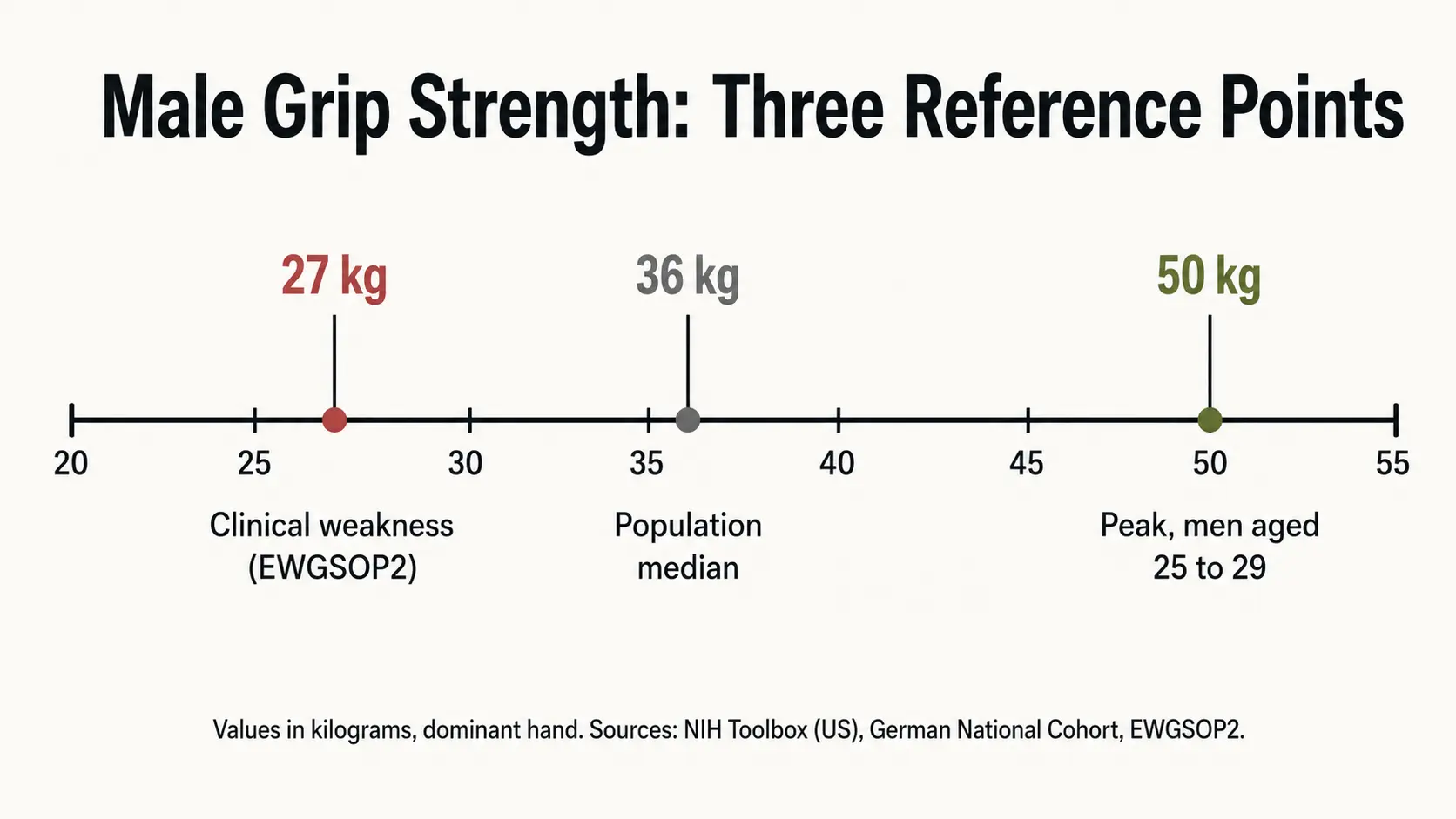
Three numbers are worth knowing, and each comes from a different kind of source, so treat them accordingly.
Peak, around 50 kg. US normative data from the NIH Toolbox project, published in the Journal of Orthopaedic & Sports Physical Therapy, puts mean dominant-hand grip strength at 49.7 kg for men aged 25 to 29. That is the top of the curve. It declines from there.
Middle of the pack, around 36 kg. A German cohort of over 200,000 adults reported a median of 36 kg for men. Population medians shift somewhat by country and measurement protocol, so read this as an orientation point rather than a target.
Clinical weakness, below 27 kg. The European Working Group on Sarcopenia in Older People sets probable sarcopenia at grip strength under 27 kg for men. This is a diagnostic threshold used in actual clinical practice, not a fitness benchmark. Some researchers argue it is set too low and miss cases as a result. A German analysis of the same population data suggested 29 kg would catch more men who are genuinely at risk.
Two things follow from these numbers.
First, the gap between peak and clinical weakness is enormous. Roughly 50 kg down to 27 kg. That decline is a slope most men walk down slowly, without ever measuring it. Very few fall off a cliff at 70.
Second, and more useful: your absolute number matters less than your trend. A 45-year-old at 38 kg who was at 38 kg last year is in a very different position from a 45-year-old at 38 kg who was at 44 kg last year. One reading tells you where you are. Two readings a year apart tell you where you are going.
How to Measure It in Ten Seconds
A hand dynamometer costs about the price of two protein shakes. That is the entire equipment list.
The protocol used in research is straightforward. Sit with your elbow bent at roughly 90 degrees and tucked at your side. Squeeze as hard as you can for three to five seconds. Rest, repeat twice more, and record the highest of the three. Test both hands. Use the same device, the same posture, and the same time of day whenever you retest, because grip varies with fatigue and time of day more than most people expect.
Test twice a year. Write the number down somewhere you will find it in six months. That is the whole practice.
If you would rather not buy anything, two rough proxies track the same underlying capacity. A dead hang from a pull-up bar, timed to failure. A farmer’s carry with heavy dumbbells, distance covered before your hands give out. Neither gives you a number you can compare to published research, and both will tell you honestly whether you are getting stronger or weaker year over year.
The Part Everyone Skips
Search for grip strength and longevity and you will find a thousand articles telling you to train your grip so you live longer.
The PURE authors are more careful than that. Their own conclusion, in the paper itself, states that further research is needed to identify the determinants of muscular strength and to test whether improvement in strength actually reduces mortality.
Read that again, because it is the single most important sentence in this entire topic. The researchers who produced the famous finding explicitly flagged that the useful version of the question remains open.
This is the difference between correlation and causation, and here it has a practical edge. Grip strength predicts mortality because it reflects total muscle, neural function, and accumulated health. If you improve the readout without improving any of those, you have improved nothing. You have adjusted the scale.
Which is exactly what a hand gripper does. Squeeze one daily for three months and your dynamometer score will very likely rise, because you have trained the specific movement the test measures. Your total muscle mass, cardiovascular health, and metabolic function will be unchanged. You will have a better number and the same body.
Nobody is going to tell you this while selling you a gripper.
What Actually Moves the Thing the Number Measures
If grip strength is a proxy for total strength and muscle mass, the way to improve what it measures is to build total strength and muscle mass. Unglamorous, and it follows directly from the logic.
Lift things that are heavy and require holding on. Deadlifts, rows, pull-ups, farmer’s carries. These build grip as a byproduct of building the rest of you, which is the correct order of operations. Two or three sessions a week is enough.
Stop using straps for everything. Lifting straps are useful when grip is the limiting factor on a heavy pull and you need to load the target muscle. Used on every set, they systematically train your back while excusing your hands. Save them for your heaviest work.
Carry things. Groceries in one trip. A loaded suitcase up stairs instead of rolling it. Heavy dumbbells for 40 meters at the end of a session. Loaded carries are the closest thing to a direct transfer between gym strength and the kind of strength that shows up on a dynamometer.
Eat enough protein. Muscle you do not feed does not stay. This becomes progressively more true after 40, when the same protein intake produces less muscle protein synthesis than it did at 25.
Keep the aerobic base. Muscle mass and cardiorespiratory fitness are separate systems that both predict mortality, and training one does relatively little for the other. Zone 2 work builds the engine that strength training does not touch.
None of this is a grip program. That is the point. The men with strong hands at 60 are almost never the men who trained their hands. They are the men who kept lifting, kept moving, and kept eating like someone who intends to be around a while. If your job keeps you seated for nine hours, what that actually does to the body is worth understanding first.
And this only works if it accumulates. Two sessions a week for twenty years beats six sessions a week for two months, and the reasons men default to the second pattern are worth understanding on their own, which is the subject of why men struggle with discipline.
When Weak Grip Strength Means Something Else
A grip score well below what your age and training history would predict deserves a look rather than a training program.
Sudden or one-sided weakness can point to nerve compression, cervical spine issues, or carpal tunnel syndrome. Grip that has fallen sharply across both hands alongside general fatigue can accompany thyroid problems, anemia, vitamin D deficiency, or other conditions that also drain energy. The hidden causes behind persistent exhaustion overlap substantially with the causes of unexplained weakness, which is not a coincidence.
Persistent joint pain during the test is also worth mentioning to a doctor rather than training through. Grip strength is a screening signal, and screening signals are only useful when someone acts on what they reveal.
The Honest Summary
Grip strength is one of the best-evidenced, least-used health markers available to you. It predicts mortality better than your blood pressure. It costs almost nothing to measure. Ten seconds, twice a year, and you have a trend line on something that genuinely matters.
What it will not do is respond to being gamed. Squeezing a gripper improves your score without improving your health, and the studies everyone cites are careful to say that improving the number has not been shown to change the outcome.
So measure it, write it down, and check it again in six months. Then go and do the boring work that actually builds the body the number is reporting on.
The gauge is worth reading. It was never worth adjusting.
References
- Leong DP, Teo KK, Rangarajan S, et al. Prognostic value of grip strength: findings from the Prospective Urban Rural Epidemiology (PURE) study. The Lancet. 2015;386(9990):266-273.
- Wu Y, Wang W, Liu T, Zhang D. Association of Grip Strength With Risk of All-Cause Mortality, Cardiovascular Diseases, and Cancer in Community-Dwelling Populations: A Meta-analysis of Prospective Cohort Studies. Journal of the American Medical Directors Association. 2017;18(6):551.e17-551.e35.
- Ortega FB, Silventoinen K, Tynelius P, Rasmussen F. Muscular strength in male adolescents and premature death: cohort study of one million participants. BMJ. 2012;345:e7279.
- Wang YC, Bohannon RW, Li X, Sindhu B, Kapellusch J. Hand-Grip Strength: Normative Reference Values and Equations for Individuals 18 to 85 Years of Age Residing in the United States. Journal of Orthopaedic & Sports Physical Therapy. 2018;48(9):685-693.
- Cruz-Jentoft AJ, Bahat G, Bauer J, et al. Sarcopenia: revised European consensus on definition and diagnosis (EWGSOP2). Age and Ageing. 2019;48(1):16-31.
- Steinbrecher A, Berger K, Bohn B, et al. Grip strength values and cut-off points based on over 200,000 adults of the German National Cohort: a comparison to the EWGSOP2 cut-off points. Age and Ageing. 2023;52(1):afac324.
FAQ
Q1. What is a good grip strength for a man?
US normative data puts mean dominant-hand grip strength at about 49.7 kg for men aged 25 to 29, which is the peak of the curve. A German cohort of over 200,000 adults reported a median of 36 kg for men across all ages. Clinical weakness is defined at under 27 kg. Your trend over time is more informative than any single reading.
Q2. Does grip strength really predict how long you will live?
It predicts mortality risk at a population level. The PURE study of 139,691 adults found every 5 kg reduction in grip strength was associated with a 16 percent increase in all-cause mortality, making it a stronger predictor than systolic blood pressure. That is a statistical association across large groups, not a prediction about any individual.
Q3. Will squeezing a hand gripper help me live longer?
There is no evidence that it will. Grip strength predicts mortality because it reflects total muscle mass, nervous system function, and accumulated health. Training the specific movement improves your score without changing what the score measures. The PURE authors themselves noted that whether improving strength reduces mortality remains untested.
Q4. How do I measure my grip strength at home?
Use a hand dynamometer. Sit with your elbow at about 90 degrees and tucked at your side, squeeze maximally for three to five seconds, rest, and repeat twice more. Record the highest of three attempts for each hand. Retest with the same device, posture, and time of day.
Q5. What exercises actually improve grip strength?
Compound movements that require holding heavy loads: deadlifts, rows, pull-ups, and loaded carries. These build grip as a byproduct of building total strength, which is the underlying capacity the measurement reflects. Reducing your reliance on lifting straps also helps.
Q6. Why does grip strength decline with age?
Grip strength peaks in the late twenties and declines with age-related muscle loss, known as sarcopenia. The rate of decline is heavily influenced by activity level, protein intake, and overall health, which is why two men of the same age can differ by 15 kg or more.
Q7. Should I see a doctor about weak grip strength?
Yes, if the weakness is sudden, affects one hand more than the other, or comes alongside unexplained fatigue. One-sided weakness can indicate nerve compression or cervical spine issues, while a sharp bilateral decline can accompany thyroid problems, anemia, or vitamin deficiencies.
Medical disclaimer: This article is for educational purposes only and is not medical advice, diagnosis, or treatment. Individual results vary. Always consult a qualified physician about your own health, especially before starting a new exercise program, changing your diet, or taking any supplement.