

Morning Erections and Erectile Dysfunction: What the Signal Means (And What It Doesn’t)
There is a question a lot of men carry around without ever asking it out loud.
If I still get morning erections, why does nothing work when it actually counts?
It feels like a contradiction, like the body is playing a joke with the timing. It isn’t. That gap between what happens at 6 a.m. and what happens at 11 p.m. is one of the most useful pieces of information a man can have about his own situation, and almost nobody is ever taught how to read it.
So let’s understand it properly, including the parts where it doesn’t tell you what you think it does.
Three ways an erection happens, and only one of them involves your thoughts
Most men have lived in their bodies for decades without ever being told that erections arrive through more than one route. There are three, and they run on separate circuitry.
The first is psychogenic. A thought, an image, a memory, a conversation. Something activates the brain’s emotional and motivational centers, and a signal travels down through the spinal cord. This is the pathway behind the erections that come with desire.
The second is reflexogenic. Direct physical stimulation activates nerve pathways at the level of the spinal cord itself, specifically the sacral segments S2 through S4. This route can produce an erection with no conscious mental arousal involved at all.
The third runs entirely on its own schedule, and it is the one that matters here. Nocturnal penile tumescence, usually shortened to NPT, is the set of spontaneous erections that occur during REM sleep. Several of them, most nights. Men typically notice only the last one, on waking, and call it morning wood.
It is not a leftover from a dream. It is not caused by a full bladder, whatever you absorbed as a teenager. It is a maintenance cycle, and the physiology behind it is well established.
What your body is doing at four in the morning
Erectile tissue needs oxygen. Oxygenated blood is what keeps it elastic and healthy, and tissue that goes long enough without it starts to change.
Nocturnal erections push oxygenated blood through the penile tissue several times a night, preserving the vascular elasticity that everything else depends on. Your body services the equipment while you are unconscious, on a schedule you never agreed to and cannot override.
Prolonged periods without reliable erections can, over time, contribute to reduced penile oxygenation and subtle fibrotic changes in the tissue. Which is one of the stronger arguments against the very common strategy of waiting a year or two to see whether this sorts itself out.
Why the sleeping brain is an honest witness
NPT is driven by a neurological mechanism that operates largely independent of your conscious psychological state. Your sleeping brain is not rehearsing the conversation you are dreading. It is not scanning for signs of failure. It is not running the anxiety loop that may be shaping everything about your waking sexual life.
It is cycling through REM sleep and sending the signals it was built to send.
Which means nocturnal erections function as a kind of unsupervised test of the underlying hardware. The vascular system, the nerve pathways, and the hormonal environment all have to be working reasonably well for NPT to happen at all. When your conscious mind is offline and the erection still shows up, you have learned something real about the machinery.
This is why formal overnight tumescence testing, using a device worn during sleep, exists as a clinical tool for distinguishing psychogenic from organic ED in unclear cases. The at-home version is cruder. It is also free, and for most men it points in roughly the right direction.
If the answer is yes
Regular, firm morning erections alongside unreliable erections with a partner is a meaningful pattern. It suggests, fairly strongly, that your vascular, neurological, and hormonal infrastructure is essentially intact, and that the primary driver sits on the psychological side: performance anxiety, relationship strain, situational stress, or the self-reinforcing loop that forms after a few bad nights.
For a lot of men, that single realization changes the emotional weight of the whole thing. The equipment is not failing. The conditions under which you are asking it to work are.
That does not make the problem smaller or easier, and it should not be read as “it’s all in your head,” which is both dismissive and inaccurate. Anxiety is not imaginary. It activates the sympathetic nervous system, and sympathetic activation actively opposes the physiological state an erection requires. The mechanism is real, physical, and measurable. It just starts somewhere other than your arteries.
If the answer is no
If you genuinely cannot remember the last time you woke up with an erection, that is a signal worth acting on rather than worrying about.
Diminished or absent NPT points toward physical factors that deserve investigation: vascular function, hormonal status, metabolic health, sleep quality, medication side effects. None of that is a verdict. Most of it is checkable with a blood draw and a proper conversation, and a good portion of it is modifiable.
The relevant point is that this is information you can take somewhere. A man with absent morning erections who books an appointment is in a considerably better position than a man with absent morning erections who has been quietly assuming the worst for eighteen months.
Where this test breaks down
Any article that presented the morning erection question as a clean binary would be overselling it, so the honest limits are worth stating plainly.
Men with anxiety-driven ED often see their nocturnal erections diminish over time as the anxiety generalizes and the whole system stays in a state of low-grade activation. So “psychological” ED can eventually produce the physical-looking pattern.
Men with mild vascular insufficiency may still have occasional morning erections, particularly early on. So “physical” ED can produce the psychological-looking pattern.
And there is a third scenario that is extremely common and routinely missed. A man develops ED for entirely physical reasons, has a few failures, starts to worry, and the worry builds an anxiety layer on top of the original problem. Correct the physical cause and the psychological layer keeps the dysfunction running on its own. That pattern, sometimes called secondary psychological ED, is one of the main reasons men do not recover erectile function even after their physical numbers improve.
Treat the morning erection question as a first-pass signal with reasonable clinical support, not a diagnosis. It tells you which direction to look first. It does not close the case.
The signals worth reading alongside it
One data point is thin. Several together start to form a picture worth trusting.
Features that lean psychological: the difficulty is situation-specific rather than global, onset was sudden rather than gradual, there is a clear connection in time to a stressor such as a relationship change or job loss, erections improve in lower-pressure settings, and you are under forty with no significant medical risk factors.
Features that lean physical: erections are absent in every situation including masturbation and sleep, onset was gradual over months or years, libido has dropped alongside erectile function, you have a history of diabetes, hypertension, or cardiovascular disease, or you take medications with known sexual side effects.
Most men who look honestly find items in both columns. That is the normal result, not a failure of the exercise. Mixed presentations are the rule, and the practical consequence is that both sides need attention rather than one.
The part of this that has nothing to do with sex
There is a reason absent nocturnal erections deserve a doctor’s attention rather than a supplement order, and it goes well beyond the bedroom.
Erections depend on nitric oxide, which is produced by the endothelium, the cell layer lining the inside of blood vessels. That same endothelium lines every artery in your body, including the ones feeding your heart and brain. When endothelial function declines, nitric oxide production falls everywhere at once.
The penile artery is roughly 1 to 2 mm across. The coronary arteries are roughly 3 to 4 mm. The smaller vessel shows the consequences of impaired blood flow earlier and more obviously than the larger one, which is why vascular ED often precedes a first cardiac event by an average of 3 to 5 years. The evidence behind this relationship is strong, and it is the consensus position of major cardiovascular and urology bodies.
Read that as an opportunity rather than a threat. It means erectile difficulty can function as an early warning with a meaningful intervention window, and it means the work you do on cardiovascular health serves your erections and your longevity at the same time. Those are not competing projects.
What to actually do with this
Start by answering the question honestly. Over the past month, how often have you woken up with a firm erection? Several times a week, occasionally, almost never, or not at all? Note it down rather than estimating from memory later, because memory is unreliable on exactly the topics we would prefer not to think about.
Then, if the answer is anything other than “regularly,” book the appointment. A proper evaluation is not complicated and it is not a big ask. At minimum it should include morning fasting total testosterone, fasting blood glucose and HbA1c, a lipid panel, thyroid function, and a full blood count. Prolactin and liver function are reasonable additions. Ten minutes and a blood draw.
If the conversation feels impossible to open, borrow a sentence: “I’ve been having problems with erections for the past few months. I’d like to understand what’s causing it rather than just get a prescription. Can we run some bloods and go through the possible causes?”
That is a request for a clinical evaluation of a common medical condition. It is not a confession. Any physician worth their license will treat it as the former.
And if all you come away with is a prescription and no investigation, you have been underserved. You are entitled to ask for the tests, or to ask for a referral.
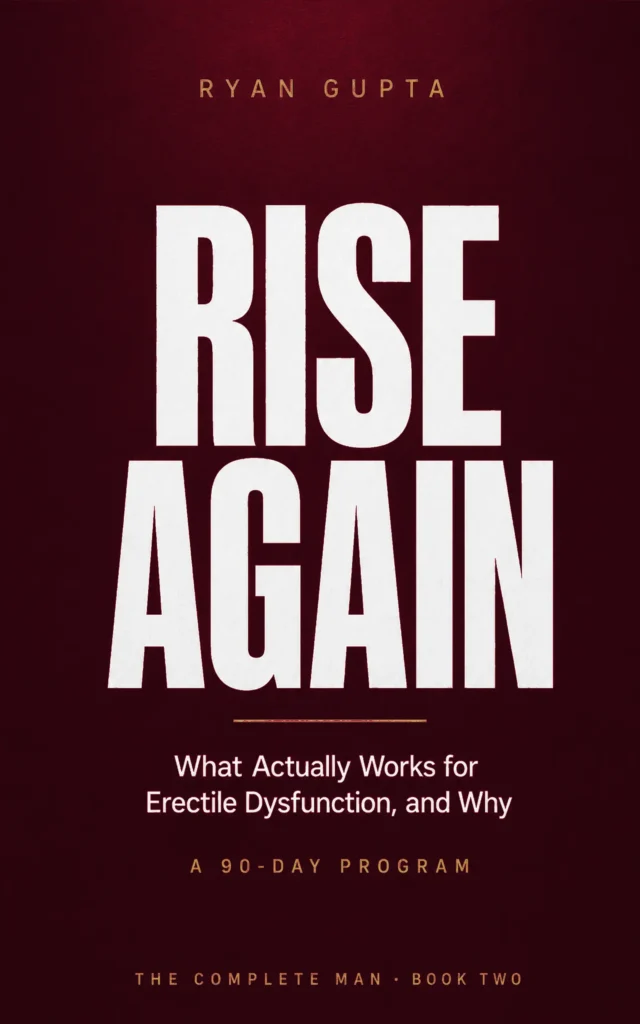
R.K. Gupta writes The Complete Man series under the pen name Ryan Gupta, a set of evidence-based guides for men on physical, sexual, and psychological health. Book Two, Rise Again: The Complete Guide to Overcoming Erectile Dysfunction, covers the full diagnostic picture in depth, including the physical and psychological recovery paths and what a genuine 90-day plan looks like.
Disclosure: This is my own book. If you purchase through this link I may earn a commission as an Amazon Associate, at no extra cost to you.
References
- Schmidt MH, Schmidt HS. Sleep-related erections: neural mechanisms and clinical significance. Current Neurology and Neuroscience Reports. 2004;4(2):170-178. PMID: 14984691. Link
- Leslie SW, Sooriyamoorthy T. Erectile Dysfunction. In: StatPearls [Internet]. Treasure Island (FL): StatPearls Publishing. Updated January 9, 2024. PMID: 32965924. Link
- Burnett AL, Nehra A, Breau RH, et al. Erectile Dysfunction: AUA Guideline. The Journal of Urology. 2018;200:633. Link
- Montorsi F, Briganti A, Salonia A, et al. Erectile dysfunction prevalence, time of onset and association with risk factors in 300 consecutive patients with acute chest pain and angiographically documented coronary artery disease. European Urology. 2003;44(3):360-364. PMID: 12932937. Link
- Montorsi P, Ravagnani PM, Galli S, et al. The artery size hypothesis: a macrovascular link between erectile dysfunction and coronary artery disease. The American Journal of Cardiology. 2005;96(12B):19M-23M. PMID: 16387561. Link
- Kloner RA, Burnett AL, Miner M, et al. Princeton IV consensus guidelines: PDE5 inhibitors and cardiac health. The Journal of Sexual Medicine. 2024;21:90-116. Link
- Nehra A, Jackson G, Miner M, et al. The Princeton III Consensus recommendations for the management of erectile dysfunction and cardiovascular disease. Mayo Clinic Proceedings. 2012;87(8):766-778. PMID: 22862865. Link
- DeFade BP, Carson CC 3rd, Kennelly MJ. Postprostatectomy erectile dysfunction: the role of penile rehabilitation. Reviews in Urology. 2011;13(1):6-13. PMID: 21826123. Link
- Xu J, Chen Y, Gu L, et al. Hypothalamic-pituitary-adrenal axis activity and its relationship to the autonomic nervous system in patients with psychogenic erectile dysfunction. Frontiers in Endocrinology. 2023;14:1103621. Link
FAQ
Does getting morning wood mean I don’t have erectile dysfunction?
No. It means the underlying physical machinery is likely working, which is useful information, but you can have regular morning erections and still have significant erectile dysfunction with a partner. That pattern points toward a psychological driver rather than ruling out ED.
How many erections should I be getting at night?
Healthy men typically have 3 to 6 erections during sleep, with an average duration of more than 30 minutes each. You will only ever be aware of the last one, so counting is not the point. What carries more information than any target figure is your own trend. A man who used to wake up with erections most mornings and now almost never does has learned something real, regardless of where either number sits against an average.
Do morning erections just stop as you get older?
Not in the way most men assume. Sleep researchers describe REM-related erections as a robust finding in healthy men irrespective of age. Erectile function does change over a lifetime, and so does sleep architecture, but a clear decline to almost nothing is not something to file under normal aging without checking. It is one of the more common reasons men delay an evaluation for years.
Does morning wood mean my testosterone is fine?
Not on its own. Low testosterone is associated with reduced nocturnal and morning erections, but the relationship is not tight enough for morning wood to rule it out. The AUA guideline recommends a morning serum total testosterone as part of the standard workup for erectile dysfunction, and that recommendation does not change based on whether you wake up with erections.
Is there an actual test for this, or is it just self-assessment?
Both exist. Formal sleep-related erection testing measures tumescence and rigidity overnight, either with a home device or in a sleep lab, and normal tracings point toward psychological causes while abnormal ones point toward organic causes. In practice it is rarely ordered now, because a careful sexual history usually reaches the same conclusion. What your doctor is more likely to use is a validated questionnaire such as the IIEF or its five-question short form, the SHIM, which gives a numerical baseline to track against.
I’m not that bothered about sex. Is ED still worth investigating?
Yes, and this is the part most men are never told. Erectile dysfunction is now treated by major cardiology and urology bodies as a recognized risk marker for cardiovascular disease, not just a sexual complaint. In men with confirmed coronary disease who had both problems, erectile difficulty arrived first about two thirds of the time, by an average of a little over three years. Getting it evaluated is a cardiovascular decision as much as a sexual one.
I get morning erections but can’t stay hard with my partner. What does that mean?
It is one of the more recognizable patterns in erectile dysfunction, and it usually points to performance anxiety or another psychological factor rather than a vascular or hormonal problem. Your body demonstrates its capability every night when nobody is watching. The difficulty appears when evaluation enters the room.
What causes morning erections to stop?
Several things, and they are worth separating. Vascular disease, low testosterone, diabetes and metabolic dysfunction, poor or fragmented sleep, and a number of common medications all reduce nocturnal erections. Long-running anxiety can reduce them too, which is why absent morning wood is a reason to investigate rather than a diagnosis on its own.
Can anxiety alone stop morning erections?
It can contribute. Anxiety-driven erectile dysfunction often shows normal morning erections early on, but as the anxiety generalizes and the nervous system stays in a state of chronic low-grade activation, nocturnal erections can diminish as well. Research on men with psychogenic ED has found measurable autonomic dysregulation, with impaired parasympathetic tone and sympathetic dominance. This is one of the reasons the morning erection test becomes less reliable the longer the problem has been running.
Medical disclaimer: This article is for educational purposes only and is not medical advice, diagnosis, or treatment. Individual results vary. Always consult a qualified physician about your own health, especially before starting a new exercise program, changing your diet, or taking any supplement.