

What Sitting All Day Does (And What Cancels It Out)
There is no amount of exercise that makes smoking safe. That is more or less what makes smoking smoking.
There does appear to be an amount of exercise that makes sitting safe. Researchers found it by pooling data on more than a million people, and published the result in The Lancet in 2016.
Which means the phrase you have heard a hundred times, sitting is the new smoking, is a category error rather than a warning. It also means the real finding is considerably more useful than the slogan, and almost nobody repeats it.
If you are sitting all day for a living, this is the version worth knowing: what the evidence actually says, how much activity it takes to cancel the risk, why one specific kind of sitting refuses to be cancelled, and what to do if you cannot hit the number.
What the Million-Person Study Found
In 2016, Ulf Ekelund and colleagues published a harmonised meta-analysis pooling individual data from 1,006,091 adults, among whom 84,659 died during follow-up. The question was specific: does physical activity reduce the mortality risk associated with prolonged sitting, or does sitting carry its own independent damage regardless?
They split participants into four groups by activity level and then looked at sitting time within each group, using people who sat less than four hours a day as the comparison.
Among the least active, more sitting meant clearly higher mortality. That is the finding everybody quotes.
Among the most active quartile, the association disappeared. Men and women doing roughly 60 to 75 minutes of moderate-intensity activity per day showed no increased risk of death even when they sat for more than eight hours a day.
The authors’ own phrasing was that high levels of moderate activity “seem to eliminate” the increased risk associated with high sitting time. Eliminate is a strong word, and they used it in The Lancet.
So the problem was never the chair. It was the chair plus a body that never moves.
The Number Nobody Likes
Before this turns into permission to stay seated, look at what 60 to 75 minutes a day actually means.
The four activity groups in the study worked out to roughly 5 minutes a day in the least active quartile, 25 to 35 minutes in the second, 50 to 65 minutes in the third, and 60 to 75 minutes in the most active. The group that fully escaped the risk was the top 25 percent.
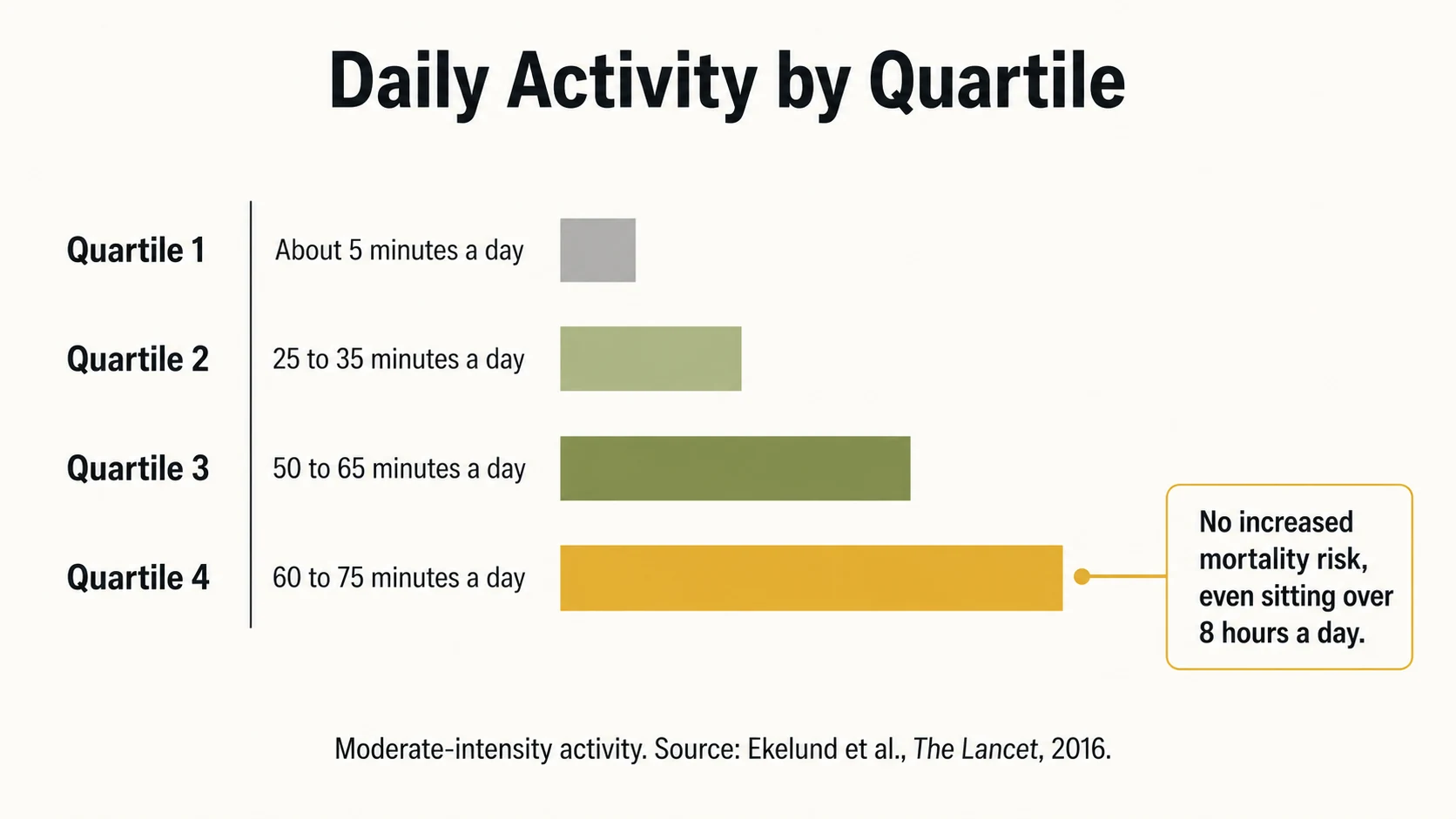
An hour of moderate activity every single day is roughly double the standard public health recommendation of 150 minutes a week. It is a brisk walk of an hour, or 40 minutes of proper training, seven days a week, indefinitely.
Most men who sit at a desk for nine hours are not doing that. Most men who believe they are doing that are counting a gym session three times a week and rounding generously.
The honest reading of this study is therefore not that sitting is harmless. It is that sitting is offsettable, at a dose of activity high enough that most desk workers are nowhere near it. Which puts you in the third quartile, where the risk is reduced but still present, and where the practical question becomes what else you can do.
Why Television Refuses to Cancel
The same study looked separately at television viewing, and found something the sitting data did not show.
High activity attenuated the risk associated with heavy TV viewing. It did not eliminate it. Among people watching more than five hours of television a day, the least active group showed a 93 percent increase in mortality risk. In the most active group, that increase fell to 16 percent.
Better, and not gone.
The obvious question is why five hours of sitting in front of a screen at home behaves differently from eight hours of sitting at a desk. The likely answer is that television time is not purely a measure of sitting. It travels with other things: snacking, later bedtimes, lower income, existing illness that keeps someone at home. Any of those could carry risk that the sitting itself does not.
Which is worth holding onto as a general principle. When one form of a behavior behaves differently from another form of the same behavior, the difference is usually telling you that something else is riding along.
What Sitting Actually Does to the Body
Setting mortality aside, sitting for long uninterrupted stretches does measurable things in the short term.
Glucose handling degrades. Skeletal muscle is the largest disposal site for blood glucose in the body, and contracting muscle clears it far more effectively than resting muscle. Sit still for hours after a meal and glucose stays elevated longer than it needs to. Sustained over years, that pattern shows up in the blood markers covered in what your cholesterol panel is actually measuring.
Hip flexors shorten and glutes stop working. Spend most of the day with your hips at 90 degrees and the tissue adapts to that position. The knock-on effect shows up as lower back discomfort and a glute that does not fire properly when you finally ask it to.
Circulation slows in the legs. The calf muscles act as a pump that helps return blood upward. Immobile calves stop pumping.
Energy drops without any physical work being done. This is the part that confuses people most. A day spent sitting leaves many men more exhausted than a day spent moving, and the mechanism is not fatigue in any muscular sense. Inactivity feels almost identical to tiredness, which is why the least active men are often the ones most convinced they are too tired to train.
None of these are dramatic on any single day. They accumulate over years, and the accumulation is what the mortality data eventually picks up.
Do Movement Breaks Actually Work?
Every article on this subject tells you to stand up every 30 minutes. The advice is reasonable. The evidence behind it is thinner than the confidence with which it is delivered.
Research on brief activity breaks, typically two to five minutes every 30 to 60 minutes, does show acute improvements in how the body handles glucose and insulin. A recent systematic review rated the certainty of that evidence as moderate for insulin outcomes, low for glucose outcomes, and very low for blood lipid outcomes.
Read those gradings honestly. Moderate certainty is genuinely useful. Very low certainty means the effect might not be there at all.
The reviewers’ own conclusion was that activity breaks are worth doing and should be combined with structured exercise rather than substituted for it. Which is the same message the Ekelund data delivers from a different direction. Breaking up your sitting helps at the margins. It does not replace training.
The Standing Desk Question
Standing desks are sold on the strength of the sitting research, and the logic does not survive contact with the detail.
Standing burns only marginally more energy than sitting. Standing muscles are largely static, so the glucose-clearing effect of actual contraction is mostly absent. And prolonged standing brings its own problems, including lower back and lower limb discomfort, which is well documented among people whose jobs require it.
The benefit in the research comes from movement, not from vertical posture. A standing desk that gets you walking around more is useful because of the walking. A standing desk you stand at motionless for four hours is mostly a different way to be still.
Buy one if you like it. Just do not buy one expecting the mortality data to come with it.
What to Actually Do
In priority order, weighted by what the evidence supports rather than by what is easiest to sell.
1. Get the daily activity total up. This is the intervention with a million-person study behind it and nothing else comes close. Sixty minutes of moderate activity a day is the target the research points at. If that is out of reach today, understand that the third quartile at 50 to 65 minutes still showed substantially reduced risk. The dose-response is your friend here. Every additional block of activity moves you up a quartile.
2. Make most of it easy. An hour a day at hard intensity is unsustainable and unnecessary. Brisk walking counts. Zone 2 work counts, and builds aerobic capacity while it does. The reason most desk workers fail at this target is that they aim for intensity instead of volume.
3. Attach movement to things that already happen. A walk after lunch, every day. Stairs instead of the lift. Walking during phone calls. Habits tied to an existing event survive; habits that require remembering do not.
4. Break up the longest blocks. Two to five minutes of movement every 30 to 60 minutes has moderate evidence behind it for insulin handling. Set an alarm if you need one. This is worth doing and it is fourth on the list for a reason.
5. Cap the evening screen block. The TV finding is the one part of this data that activity could not fully offset. Whether that reflects sitting or everything that comes with a five-hour evening in front of a screen, it is the one behavior the study flagged as stubborn.
6. Keep building capacity. A body with more aerobic capacity and more muscle handles a sedentary job better than one without. Strength training two or three times a week earns its place here for a different reason than the others. It changes what your body is when it does sit.
The Honest Summary
Sitting is not the new smoking. There is a dose of activity that appears to cancel its mortality risk entirely, and no such dose exists for cigarettes.
That is genuinely good news, and it comes with a condition most people skip. The dose is about an hour of moderate movement a day, which puts it in the top quartile of a million-person sample. If you are doing forty minutes three times a week and telling yourself you are covered, the data does not support that.
Standing desks are mostly beside the point. Movement breaks help modestly. Neither is a substitute for the total volume.
The chair was never the enemy. Nine hours in the chair followed by an evening on the sofa is a different matter, and no gadget fixes it. An hour on your feet, most days, does.
References
- Ekelund U, Steene-Johannessen J, Brown WJ, et al. Does physical activity attenuate, or even eliminate, the detrimental association of sitting time with mortality? A harmonised meta-analysis of data from more than 1 million men and women. The Lancet. 2016;388(10051):1302-1310.
- Piercy KL, Troiano RP, Ballard RM, et al. The Physical Activity Guidelines for Americans. JAMA. 2018;320(19):2020-2028.
- Morris JN, Heady JA, Raffle PAB, Roberts CG, Parks JW. Coronary heart disease and physical activity of work. The Lancet. 1953;262(6795):1053-1057.
- Centers for Disease Control and Prevention. Physical Activity Guidelines for Adults.
- World Health Organization. Physical Activity Fact Sheet.
FAQ
Q1. Is sitting all day really as bad as smoking?
No, and the comparison fails on its own logic. A 2016 Lancet meta-analysis of more than one million adults found that roughly 60 to 75 minutes of moderate daily activity eliminated the increased mortality risk associated with sitting more than eight hours a day. No dose of exercise makes smoking safe, which is precisely why the analogy does not hold.
Q2. How much exercise cancels out sitting all day?
In that meta-analysis, the group showing no increased risk despite high sitting time was doing about 60 to 75 minutes of moderate-intensity activity per day. That is roughly double standard public health guidance and represented the most active quartile of the sample.
Q3. Why is watching TV worse than sitting at a desk?
In the same study, high activity levels reduced but did not eliminate the risk associated with more than five hours of daily television. Among the least active, the risk increase was 93 percent, falling to 16 percent among the most active. Television time likely travels with other factors such as snacking, later bedtimes, and existing illness.
Q4. Do standing desks improve your health?
The evidence is weaker than the marketing. Standing burns only marginally more energy than sitting, standing muscles are largely static, and prolonged standing carries its own risk of back and lower limb discomfort. The benefit in the research comes from movement rather than from standing still in an upright position.
Q5. Does standing up every 30 minutes actually help?
Modestly. Brief activity breaks of two to five minutes show acute improvements in insulin handling, with a systematic review rating that evidence as moderate certainty for insulin, low for glucose, and very low for blood lipids. The reviewers concluded breaks should complement structured exercise rather than replace it.
Q6. What happens to your body when you sit for long periods?
Glucose clearance slows because resting muscle disposes of blood sugar far less effectively than contracting muscle. Hip flexors shorten, glute activation declines, and circulation in the legs slows as the calf muscle pump stops working. None of this is dramatic in a single day, and it accumulates over years.
Q7. What if I cannot fit in an hour of activity a day?
The relationship is a dose-response rather than a threshold. The third activity quartile, at roughly 50 to 65 minutes daily, still showed substantially reduced risk compared with the least active group. Every additional block of movement moves you in the right direction.
Medical disclaimer: This article is for educational purposes only and is not medical advice, diagnosis, or treatment. Individual results vary. Always consult a qualified physician about your own health, especially before starting a new exercise program, changing your diet, or taking any supplement.