

What a Sauna Actually Does to Your Heart: The Evidence
Sixty-three percent.
That is the number you have seen. Men who used a sauna four to seven times a week had a 63 percent lower risk of sudden cardiac death than men who used one once a week. It appears in every sauna article, every podcast segment, and on the sales page of every home sauna company in existence.
The finding is real. It was published in JAMA Internal Medicine, it came from a serious Finnish cohort followed for two decades, and it is the single most cited piece of sauna heart health research in existence.
It also came from 201 men.
That detail changes how you should read every sauna headline you encounter, and almost nobody mentions it. What follows is the honest version: what the Finnish research found, why the sample size matters more than it sounds, what happened when a much larger study asked the same question, and what a reasonable person should actually do with any of it.
What the Finnish Study Actually Found
The Kuopio Ischaemic Heart Disease Risk Factor Study, usually shortened to KIHD, recruited 2,315 apparently healthy men aged 42 to 60 from eastern Finland between 1984 and 1989. Researchers asked them how often they used a sauna, then followed them for a median of 20.7 years using Finland’s national death registry.
Over that period the study recorded 190 sudden cardiac deaths, 281 fatal coronary heart disease events, 407 fatal cardiovascular events, and 929 deaths from any cause.
Compared with men who used a sauna once a week, the men using one four to seven times a week showed a 63 percent lower risk of sudden cardiac death, 48 percent lower risk of fatal coronary heart disease, 50 percent lower risk of fatal cardiovascular disease, and 40 percent lower all-cause mortality.
The same cohort produced a second widely quoted result. A 2017 paper in Age and Ageing reported that the four-to-seven group had a 66 percent lower risk of dementia and a 65 percent lower risk of Alzheimer’s disease.
Those are enormous effect sizes. Very few interventions in medicine produce numbers like that. Which is exactly the reason to look at how they were produced.
The Problem With 201 Men
Of the 2,315 participants, 601 reported using a sauna once a week, 1,513 used one two to three times a week, and 201 used one four to seven times a week.
Every headline number in every sauna article you have read comes from that third group. Two hundred and one men, in one region of one country, whose sauna habits were recorded once, on a questionnaire, in the 1980s, and never updated for the following twenty years.
Three problems follow from that, and they compound.
Small groups produce unstable estimates. The dementia result illustrates this cleanly. The hazard ratio for the four-to-seven group was 0.34, with a 95 percent confidence interval running from 0.16 to 0.71. That interval is enormous. The data are consistent with an 84 percent reduction and equally consistent with a 29 percent reduction. Reporting the midpoint as though it were the answer hides most of the uncertainty.
The middle group mostly did not show the effect. For dementia, men using a sauna two to three times a week had a hazard ratio of 0.78 with a confidence interval of 0.57 to 1.06. That interval crosses 1.0, which in plain terms means the study could not distinguish their risk from the once-a-week group. If sauna use had a smooth protective dose-response, you would expect this group to land clearly between the other two. It did not.
Healthy men can sauna seven times a week. Sick men cannot. This is the one that matters most. Sauna bathing is physically demanding. It raises heart rate substantially and puts real load on the cardiovascular system. A man with early undiagnosed heart disease, chronic fatigue, or declining function is less likely to be in the sauna every day, and more likely to die in the following twenty years, for reasons that have nothing to do with the sauna.
Researchers call this reverse causation, and it is the standing hazard of every observational study of a demanding health behavior. The KIHD team adjusted for age, BMI, blood pressure, cholesterol, smoking, alcohol, diabetes, prior heart attack, physical activity, and socioeconomic status. That is a serious adjustment list, and statistical adjustment cannot fully remove a factor nobody measured.
What Happened When Someone Asked 14,000 People
In 2020, a different Finnish team published a much larger test of the dementia question in Preventive Medicine Reports. They used the Finnish Mobile Clinic Follow-up Survey: 13,994 men and women aged 30 to 69, followed for 39 years, producing 1,805 diagnosed dementia cases.
Six times the participants. Twice the follow-up. Nine times the outcome events.
They found an association, and it was considerably smaller. During the first 20 years of follow-up, frequent sauna users showed a hazard ratio of 0.47. Across the full 39 years, that fell to 0.81, with a confidence interval of 0.69 to 0.97.
A 19 percent reduction in dementia risk. Real, statistically solid, and roughly a quarter the size of the number everybody quotes.
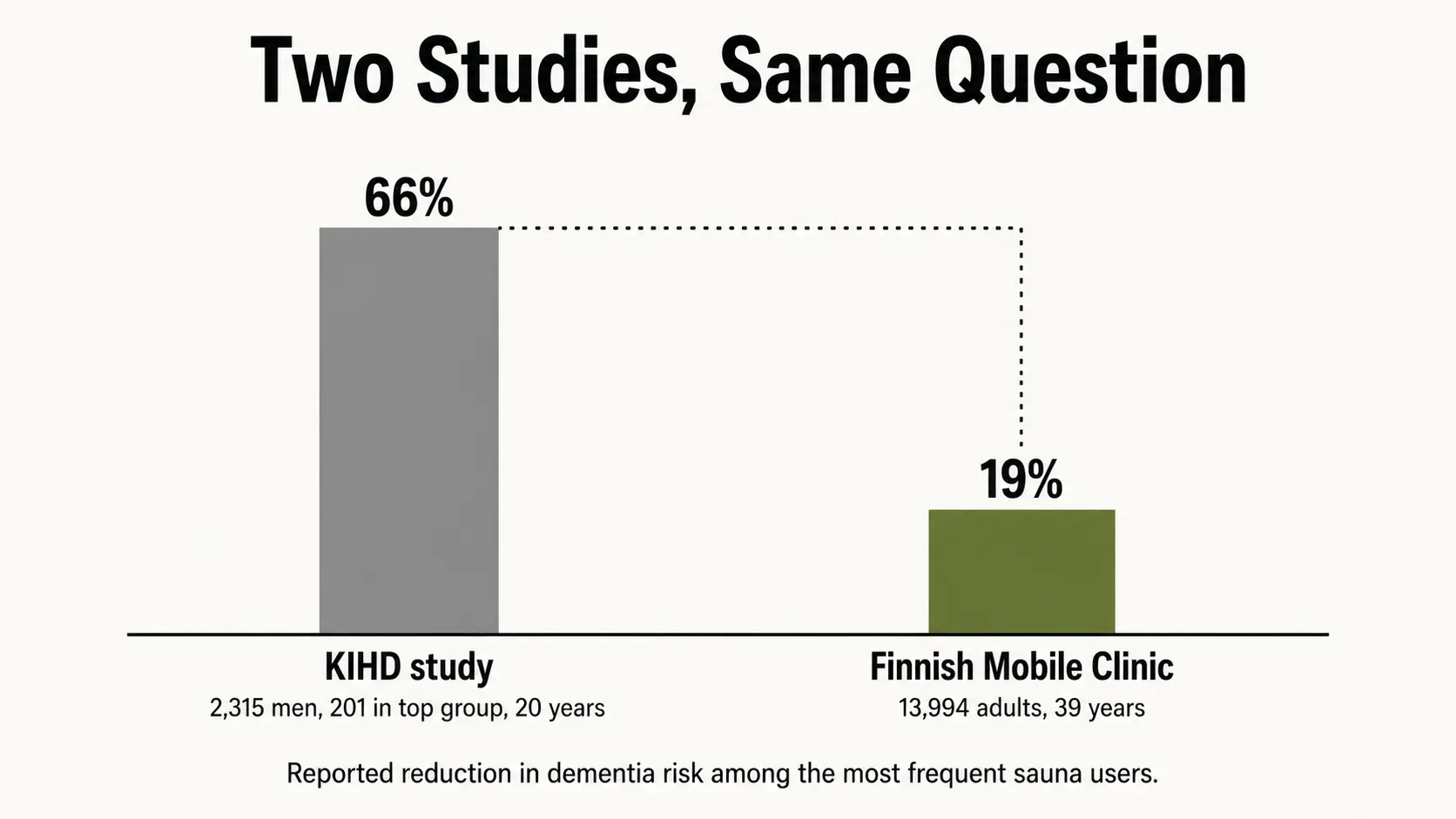
This pattern is common enough in epidemiology that researchers expect it. A striking effect appears in a small study, gets amplified everywhere, and shrinks toward something modest when larger and longer investigations arrive. The modest version is usually closer to the truth.
What the Sauna Heart Health Data Still Supports
Everything above is a case for lowering your expectations, not for skipping the sauna. Several things point the other way.
There is a plausible mechanism. Sitting in a sauna is not passive from your heart’s perspective. Core temperature rises, blood vessels dilate, blood shifts toward the skin, and heart rate climbs into a range comparable with moderate exercise. Cardiac output increases. The load is real, which is why a sauna session leaves you tired rather than refreshed.
The dose-response holds in the larger data. A 2018 study in BMC Medicine extended the analysis to 1,688 men and women and found cardiovascular mortality risk declining linearly with more sessions per week, with no obvious threshold. Smooth dose-response relationships are one of the better signals that an association reflects something real rather than an artifact.
The downside is close to zero. For a healthy adult, twenty minutes of heat carries essentially no risk and costs nothing beyond time. That asymmetry matters. An intervention with a possible modest benefit and almost no cost is worth doing even when the evidence is imperfect.
What the evidence does not support is treating a sauna as a substitute for training. The heart rate response resembles moderate exercise, and it produces none of the muscular adaptation, none of the mitochondrial changes, and none of the metabolic benefit that Zone 2 work does. VO2 max remains the far better-evidenced cardiovascular investment, and no amount of heat will build it.
A sauna is a supplement to training. It is a poor replacement for one.
What a Realistic Protocol Looks Like
The Finnish research studied traditional dry saunas at roughly 80 to 100 degrees Celsius, with sessions averaging around 15 minutes. That is the protocol the data actually describes, and worth knowing if you are comparing it to something else.
Frequency: three or more sessions a week. The associations strengthen with frequency, and the once-a-week group was the comparison baseline in every analysis. Whether daily beats four times weekly is not something 201 men can tell you.
Duration: 15 to 20 minutes. Longer sessions were associated with better outcomes in the KIHD data, and the same small-numbers caution applies. Fifteen minutes is what most of the cohort was doing.
Timing: after training or in the evening. Heat exposure followed by cooling drops core temperature below where it started, and falling core temperature is one of the signals your body uses to initiate sleep. If your sleep is inconsistent, this is a reasonable thing to test, and the wider set of reasons behind poor recovery is covered in why you can be tired after 8 hours of sleep.
Hydration: drink more than feels necessary. A 15-minute session can cost half a liter of fluid. Dehydration is the most common way an otherwise harmless sauna session goes wrong.
Infrared saunas are a different thing. They operate at much lower air temperatures and were not what any of the Finnish research studied. They may well have benefits. Those benefits have not been demonstrated by the studies people cite when recommending them.
Who Should Be Careful
Sauna use is well tolerated by most healthy adults, and it is a genuine cardiovascular load rather than a relaxing sit in a warm room.
Speak with a doctor first if you have unstable angina, a recent heart attack, severe aortic stenosis, or uncontrolled low blood pressure. The same applies if you are managing any cardiovascular condition and have not discussed heat exposure with whoever is treating it.
Alcohol and saunas are a genuinely dangerous combination. Both drop blood pressure and impair the body’s ability to regulate temperature, and Finnish data on sauna-related deaths points repeatedly at alcohol as the common factor.
Leave if you feel dizzy, nauseated, or lightheaded. Toughing it out has no benefit attached to it.
The Honest Verdict
Regular sauna use is probably good for you. The mechanism is plausible, the dose-response is consistent, and the risk for a healthy man is close to nothing.
It is probably good for you by considerably less than 63 percent.
The famous numbers come from 201 men whose habits were recorded once in the 1980s, in a country where sauna use is close to universal and the men who do it most are the men healthy enough to do it most. When a study six times the size and twice the length looked at the same question, the effect shrank to about a fifth of the headline.
None of that makes it worthless. A modest benefit, for twenty minutes and no money, is a good trade. It makes it a decent habit rather than a longevity intervention, and the distinction matters when you are deciding where your limited effort goes.
Train first. Sleep second. Then sit in the heat, because you probably will feel better afterward, and because on the balance of evidence it is more likely to help than not.
Just do not buy a sauna expecting 63 percent.
References
- Laukkanen T, Khan H, Zaccardi F, Laukkanen JA. Association Between Sauna Bathing and Fatal Cardiovascular and All-Cause Mortality Events. JAMA Internal Medicine. 2015;175(4):542-548.
- Laukkanen T, Kunutsor S, Kauhanen J, Laukkanen JA. Sauna bathing is inversely associated with dementia and Alzheimer’s disease in middle-aged Finnish men. Age and Ageing. 2017;46(2):245-249.
- Knekt P, Järvinen R, Rissanen H, Heliövaara M, Aromaa A. Does sauna bathing protect against dementia? Preventive Medicine Reports. 2020;20:101221.
- Laukkanen JA, Laukkanen T, Kunutsor SK. Cardiovascular and Other Health Benefits of Sauna Bathing: A Review of the Evidence. Mayo Clinic Proceedings. 2018;93(8):1111-1121.
- Laukkanen T, Kunutsor SK, Khan H, Willeit P, Zaccardi F, Laukkanen JA. Sauna bathing is associated with reduced cardiovascular mortality and improves risk prediction in men and women: a prospective cohort study. BMC Medicine. 2018;16:219.
FAQ
Q1. Is sauna actually good for your heart?
The evidence points that way, though less dramatically than headlines suggest. Finnish cohort studies consistently find that more frequent sauna use is associated with lower cardiovascular mortality, and the mechanism is plausible because heat raises heart rate into a range comparable with moderate exercise. These are observational studies, so they show association rather than proof of cause.
Q2. Where does the 63 percent figure come from?
From the Kuopio Ischaemic Heart Disease study published in JAMA Internal Medicine in 2015. Men using a sauna four to seven times weekly had a 63 percent lower risk of sudden cardiac death than men using one once weekly. That comparison group contained 201 men, which is worth knowing before treating the number as settled.
Q3. How often should you use a sauna?
The associations in the research strengthen with frequency, and three or more sessions per week is where the benefit becomes clear in the data. Sessions in the Finnish studies averaged around 15 minutes in a traditional dry sauna at roughly 80 to 100 degrees Celsius.
Q4. Can a sauna replace exercise?
No. Heat raises your heart rate but produces none of the muscular, mitochondrial, or metabolic adaptations that training does. A sauna is a reasonable addition to a training routine and a poor substitute for one.
Q5. Are infrared saunas as good as traditional saunas?
They may have benefits, and they have not been shown to have these benefits. Infrared saunas operate at much lower air temperatures and were not what the Finnish cohort studies examined. Citing that research to support infrared use is not supported by the data.
Q6. Does a sauna help you sleep?
Possibly. Heat exposure followed by cooling drops core body temperature below its starting point, and falling core temperature is one of the signals that initiates sleep. Evening sessions are the reasonable time to test this.
Q7. Who should avoid saunas?
Anyone with unstable angina, a recent heart attack, severe aortic stenosis, or uncontrolled low blood pressure should speak with a doctor first. Never combine alcohol with sauna use, since both lower blood pressure and impair temperature regulation, and alcohol appears repeatedly in Finnish data on sauna-related deaths.
Medical disclaimer: This article is for educational purposes only and is not medical advice, diagnosis, or treatment. Individual results vary. Always consult a qualified physician about your own health, especially before starting a new exercise program, changing your diet, or taking any supplement.