

ApoB vs LDL Cholesterol: What Your Panel Actually Measures
Imagine trying to predict how congested a highway will be by weighing the total cargo moving along it.
Two fleets could carry identical tonnage. One does it in 50 large trucks. The other does it in 200 small ones. The weight on the scale is the same. The traffic is nothing alike.
This is more or less the ApoB vs LDL cholesterol question, and it applies to the panel your doctor has been running on you for twenty years. LDL cholesterol, the number everyone watches, measures how much cholesterol is being carried. It does not count the vehicles carrying it.
Arteries are damaged by the vehicles.
There is a test that counts them, and there is also a number sitting on the panel you already have that gets you most of the way there for free. Almost nobody uses either. Here is what the evidence actually shows, who it matters for, and what to do about it without turning your health into a science project.
What Your Panel Actually Measures
A standard lipid panel gives you four numbers: total cholesterol, HDL cholesterol, triglycerides, and LDL cholesterol. On most panels, that LDL number is calculated from the other three rather than measured directly.
What LDL-C represents is the mass of cholesterol carried inside your LDL particles. Think of it as the total cargo weight.
Atherosclerosis does not work that way. Plaque forms when apolipoprotein B particles cross into the artery wall and become trapped there. Every atherogenic particle in your bloodstream carries exactly one apoB molecule. One particle, one apoB. Measuring apoB therefore gives you a direct count of how many of these particles are circulating.
Here is the part that matters. Particles vary enormously in how much cholesterol they carry. Two men can have identical LDL-C readings while one carries that cholesterol in a modest number of large particles and the other carries it in a much larger number of small, dense ones.
Same tonnage. Very different traffic. And it is the traffic that gets into the artery wall.
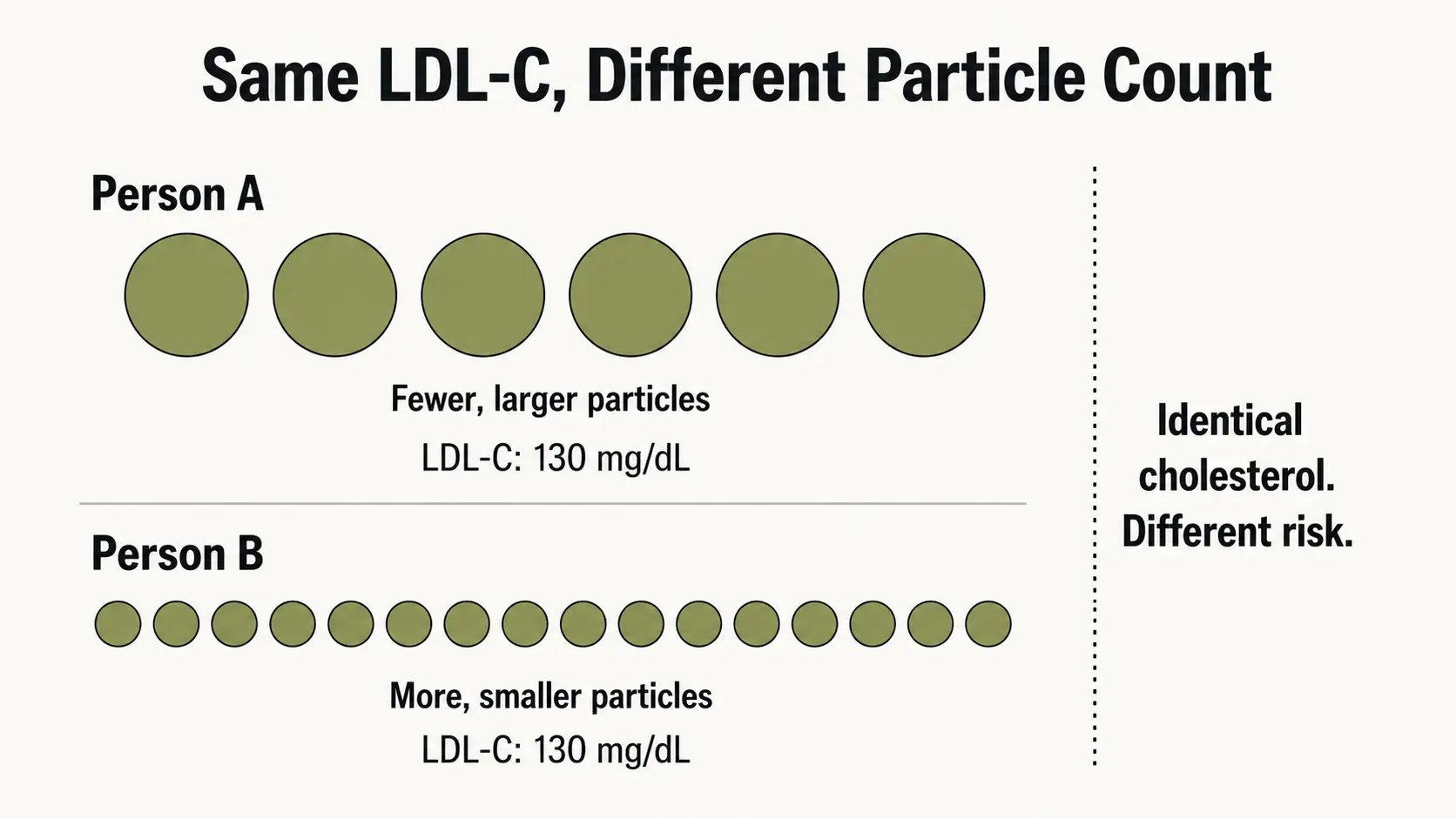
ApoB vs LDL Cholesterol: Why Particle Count Wins
This is not a fringe position. In 2019, the European Society of Cardiology and European Atherosclerosis Society reviewed the accumulated evidence from observational studies, randomized trials, and Mendelian randomization, and concluded that apoB is a more accurate marker of cardiovascular risk than either LDL-C or non-HDL cholesterol. They also noted that apoB can be measured inexpensively, and more precisely than LDL-C.
The strongest evidence comes from what researchers call discordance analysis. The logic is straightforward. LDL-C and apoB usually move together, so most of the time they tell you the same story. But in a meaningful minority of people they disagree. When they disagree, which one predicts who actually has a heart attack?
A 2025 systematic review in the Journal of Clinical Lipidology collected every discordance analysis published on the question. In nine studies out of nine, apoB was superior to LDL-C. The result was not close, and it was not mixed.
The scale of the underlying data is also worth stating plainly. A 2024 analysis in the European Heart Journal examined this in the UK Biobank across 502,413 participants and found that for any given LDL-C or non-HDL-C value, apoB levels vary enough to produce clinically meaningful differences in risk between people whose panels look identical.
If you have a longevity marker that is measured accurately, predicts events better than the standard, and costs very little, the obvious question is why it is not standard already. Inertia is most of the answer. LDL-C has decades of guidelines, drug trials, and clinical habit behind it, and systems that large do not turn quickly.
When the Two Numbers Disagree
Before you conclude your lipid panel is worthless, the honest version: for most people, most of the time, LDL-C and apoB agree. If your LDL-C is low and your metabolic health is good, your apoB is very probably low too, and the test would tell you something you already know.
Discordance is not random, though. It clusters, and it clusters in a specific and increasingly common group of men.
High triglycerides. This is the single strongest signal. Elevated triglycerides tend to shift you toward more numerous, smaller, cholesterol-poor particles. Your LDL-C can look reassuring while your particle count is high.
Metabolic syndrome or insulin resistance. The same underlying process. Central weight gain, elevated fasting glucose, and low HDL travel together, and they push the lipid profile in exactly the direction where LDL-C becomes least informative.
Type 2 diabetes. Well documented, same mechanism, and a group where the guidelines already lean toward apoB.
An LDL-C that looks fine while everything else looks off. If your triglycerides are elevated, your HDL is low, your waist has grown, and your LDL-C came back “normal,” that is precisely the pattern where the standard number is most likely to be understating what is happening.
Notice that this is the profile of a very large number of men in their forties. It is also the profile that a standard panel is worst at reading.
The Number You Already Have and Are Not Using
Here is the practical part, and it is the reason to read this article rather than just book a test.
There is a third number called non-HDL cholesterol. It captures the cholesterol carried in every atherogenic particle, not just LDL. And you do not need a new test to get it, because it is arithmetic:
Non-HDL-C = Total cholesterol minus HDL cholesterol.
Both of those numbers are on every lipid panel ever run on you. Go find your most recent results and subtract. That takes ten seconds and gives you a better risk marker than the LDL-C you have been watching.
How much better? The same systematic review that found apoB superior to LDL-C in nine out of nine studies found apoB superior to non-HDL-C in only seven out of nine. In one study they performed equally, and in one non-HDL-C came out ahead.
Read that gap carefully, because it is the useful finding hiding inside this whole topic. ApoB clearly beats LDL-C. ApoB beats non-HDL-C by a much narrower margin. Which means the free calculation you can do right now closes most of the distance between the number you have and the number the specialists want.
Nobody selling you a longevity panel is going to lead with that.
Should You Actually Get ApoB Tested?
Reasonable, and reasonable for specific reasons rather than because a podcast said so.
The case is strongest if your triglycerides are elevated, if you have metabolic syndrome or diabetes, if you have a family history of early heart disease, or if your LDL-C looks acceptable while the rest of your metabolic picture does not. In those situations, apoB genuinely can reveal risk your panel is hiding.
The case is weaker if you are lean, metabolically healthy, and your LDL-C and triglycerides are both low. Your apoB will very likely confirm what you already know.
A few practical notes. ApoB is a widely available standard laboratory test, not a specialty panel, and it is usually inexpensive. Your doctor can order it, and in many places you can order it yourself. Unlike calculated LDL-C, it does not require fasting.
What this article deliberately will not do is give you a target. Appropriate apoB levels depend on your overall cardiovascular risk, your history, and your other markers, and setting one is a clinical decision made with a doctor who can see your whole picture. Anyone handing out a universal number on the internet is guessing on your behalf.
What Actually Moves It
The interventions that lower apoB are the same ones that lower cardiovascular risk generally, which is reassuring rather than disappointing. There is no separate apoB protocol.
Get triglycerides down. Since elevated triglycerides are the main driver of the discordance that makes LDL-C misleading, this is the highest-leverage change. Refined carbohydrate and alcohol reduction move triglycerides faster than almost anything else, often within weeks.
Improve insulin sensitivity. The metabolic pattern that produces small dense particles responds to the same things that produce a healthier body composition. Losing visceral fat, in particular, tends to shift the lipid profile favorably, and the effects of sitting all day work directly against it. Several of the everyday habits that undermine this are covered in the energy mistakes most men do not realize they are making.
Train aerobically and lift. Both improve the lipid profile through partly independent routes. Zone 2 work improves the metabolic machinery that handles fat, and resistance training improves insulin sensitivity by giving glucose somewhere to go.
Eat more fiber, less ultra-processed food. Soluble fiber measurably reduces cholesterol absorption. This is one of the older and better-established findings in nutrition, and it remains unglamorous enough that it rarely gets discussed.
Take medication seriously if it is offered. Statins and related drugs lower apoB substantially, and the mortality evidence behind them is among the strongest in medicine. Declining an indicated statin because you would rather fix it with diet is a decision worth making with your doctor rather than with the internet.
None of this is a quick fix, and none of it is separate from the rest of your health. Cardiovascular risk is a system, which is why VO2 max and your lipid profile tend to improve together in men who change how they live.
The Honest Summary
Your cholesterol panel is not useless. For most men it tells a broadly accurate story.
It is weakest exactly where a lot of men now live: elevated triglycerides, expanding waist, declining insulin sensitivity, and an LDL-C that comes back looking fine. In that group, the number everyone watches understates the risk.
ApoB counts the particles that cause the disease, and the evidence favoring it over LDL-C is about as consistent as evidence in this field gets. It is worth asking your doctor about, particularly if you fit the pattern above.
And before you order anything, go find your last lipid panel and subtract HDL from total cholesterol. That number is free, it is already yours, and it closes most of the gap.
Weigh the cargo if you like. Just remember that the trucks are what hit the wall.
References
- Sehayek D, Cole J, Björnson E, et al. ApoB, LDL-C, and non-HDL-C as markers of cardiovascular risk. Journal of Clinical Lipidology. 2025.
- Sniderman AD, Dufresne L, Pencina KM, et al. Discordance among apoB, non-high-density lipoprotein cholesterol, and triglycerides: implications for cardiovascular prevention. European Heart Journal. 2024;45(27):2410-2418.
- Mortensen MB. ApoB triumphs once more over LDL-C and non-HDL-C in risk prediction: ready for guidelines? European Heart Journal. 2024;45(27):2419-2421.
- Mach F, Baigent C, Catapano AL, et al. 2019 ESC/EAS Guidelines for the management of dyslipidaemias: lipid modification to reduce cardiovascular risk. European Heart Journal. 2020;41(1):111-188.
- Boekholdt SM, Arsenault BJ, Mora S, et al. Association of LDL cholesterol, non-HDL cholesterol, and apolipoprotein B levels with risk of cardiovascular events among patients treated with statins: a meta-analysis. JAMA. 2012;307(12):1302-1309.
- Sniderman AD, Lamarche B, Contois JH, de Graaf J. Discordance analysis and the Gordian Knot of LDL and non-HDL cholesterol versus apoB. Current Opinion in Lipidology. 2014;25(6):461-467.
FAQ
Q1. What is the difference between ApoB and LDL cholesterol?
LDL cholesterol measures the mass of cholesterol carried inside your LDL particles. ApoB counts the particles themselves, since every atherogenic particle carries exactly one apoB molecule. Because plaque forms when particles enter the artery wall, counting particles is more directly related to the disease process than weighing their contents.
Q2. Is ApoB really a better predictor than LDL-C?
The evidence consistently says yes. A 2025 systematic review of discordance analyses found apoB superior to LDL-C in nine out of nine studies. The 2019 ESC and EAS guidelines reached the same conclusion after reviewing observational data, randomized trials, and Mendelian randomization.
Q3. How do I calculate non-HDL cholesterol?
Subtract your HDL cholesterol from your total cholesterol. Both numbers appear on every standard lipid panel, so you can work it out from results you already have. Non-HDL-C is a better risk marker than LDL-C and closes much of the gap to apoB at no cost.
Q4. Who should get an ApoB test?
The case is strongest for people with elevated triglycerides, metabolic syndrome, type 2 diabetes, a family history of early heart disease, or an LDL-C that looks acceptable while the rest of the metabolic picture does not. For lean, metabolically healthy people with low LDL-C and triglycerides, apoB usually confirms what the panel already showed.
Q5. What is a good ApoB level?
Appropriate targets depend on your overall cardiovascular risk, medical history, and other markers, which makes this a clinical decision rather than a universal number. Discuss your result with a doctor who can see your full picture rather than comparing it to a figure found online.
Q6. Do I need to fast for an ApoB test?
No. Unlike calculated LDL cholesterol, apoB does not require fasting, which is one of several practical advantages it has over the standard panel.
Q7. What lifestyle changes lower ApoB?
The same changes that lower cardiovascular risk generally: reducing refined carbohydrate and alcohol to bring triglycerides down, losing visceral fat, improving insulin sensitivity, training both aerobically and with resistance, and increasing soluble fiber intake. There is no separate apoB protocol.
Medical disclaimer: This article is for educational purposes only and is not medical advice, diagnosis, or treatment. Individual results vary. Always consult a qualified physician about your own health, especially before starting a new exercise program, changing your diet, or taking any supplement.