

Zone 2 Cardio Explained: Why Slow Training Builds Better Endurance
Why the slowest, most boring workout builds the biggest engine and where the hype goes too far
Zone 2 cardio is having a moment. Peter Attia has been one of its most vocal advocates. Huberman put it on the map for millions. Every fitness influencer now preaches the gospel of the slow jog. And a lot of guys hear “just go easy” and quietly assume the whole thing is soft, a permission slip to phone in your cardio.
That read is wrong. Zone 2 is one of the most effective tools you have for building a heart and metabolism that last. But the hype has also outrun the science in a few places, and you deserve the honest version, not the influencer version.
Start with what Zone 2 actually is.
Picture five gears of effort, from a stroll to an all-out sprint. Zone 2 is second gear. Physiologically, it’s the hardest you can go while your body still burns mostly fat for fuel and clears lactate as fast as it produces it. Cross above it and you tip into burning sugar and stacking up lactate. Stay in it and you’re in the metabolic sweet spot. The simplest field test: you can hold a conversation, but you’d rather not sing. Talk, yes. Belt out a chorus, no.
What Happens in Your Body: Mitochondria, Capillaries, and Fat Burning
Easy pace, real adaptations. These are the key adaptations Zone 2 training produces.
Your mitochondria multiply. These are the tiny power plants inside your muscle cells that turn fuel into usable energy. Zone 2 signals your body to build more of them, and more power plants means more capacity to make energy aerobically, which means you go faster at the same effort. This is the engine block getting bigger.
Your capillary network expands. Capillaries are the microscopic vessels that pipe oxygen into muscle. Train Zone 2 and your body lays down more of them around the fibers doing the work. More delivery pipes, more oxygen per beat, lower heart rate at the same pace. You’re upgrading the fuel lines.
And your fat-burning improves. At this intensity fat is the primary fuel, and the more you train here, the better your body gets at tapping it. That matters more than it sounds. You carry a tiny reserve of carbohydrate and a nearly bottomless reserve of fat. A body that burns fat efficiently has a vastly larger tank to draw from.
None of this is cosmetic. Higher mitochondrial and fat-oxidation capacity is consistently associated with better cardiometabolic health, including lower rates of insulin resistance and cardiovascular disease. Zone 2 builds exactly that capacity. This is heart and metabolic insurance, paid in slow miles.
Zone 2 is the engine block. Intervals are the redline. Build only one and you own half a car.
How to Find Your Zone 2 Heart Rate
Most people make the same mistake, and they make it every time: they go too hard. The “easy” pace feels so easy that the ego pushes it up into a murky middle ground too hard to get the Zone 2 benefit, too easy to get the high-intensity benefit. Runners call it the grey zone. It’s where a lot of effort goes to die.
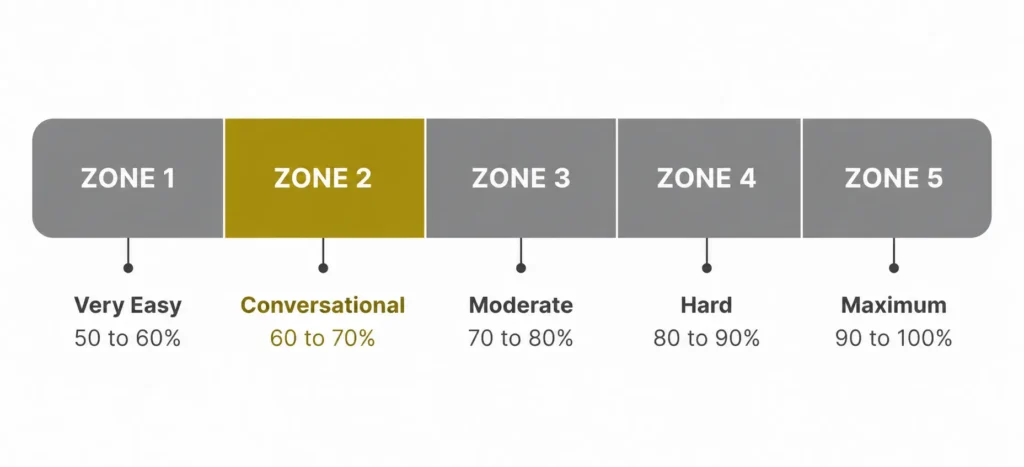
The rough math starts with your estimated max heart rate: 220 minus your age. Zone 2 sits at about 60 to 70 percent of that. For a 40-year-old, max lands near 180, putting Zone 2 somewhere around 108 to 126 beats per minute.
| Age | Estimated max HR | Zone 2 range (bpm) |
|---|---|---|
30 | 190 | 114 to 133 |
| 180 | 108 to 126 |
50 | 170 | 102 to 119 |
60 | 160 | 96 to 112 |
That formula is a starting point, not gospel. Real max heart rates vary by 10 to 20 beats from the estimate. A more personalized method uses heart rate reserve, which factors in your resting heart rate: subtract your resting rate from your max to get your reserve, then take 55 to 78 percent of that and add your resting rate back. Fussier, more accurate.
Honestly, though, for most men the talk test does the job. Can you speak a full sentence without gasping? You’re in the zone or close. Are you dropping words to catch your breath? You’ve drifted too high. Slow down, even if it feels absurdly gentle. That’s not weakness. That’s the point.
Where the hype goes too far
The influencers usually leave out one important detail.
The claim that Zone 2 is the single best intensity for building your aerobic engine doesn’t fully hold up. A 2025 review by Storoschuk and colleagues found the evidence doesn’t robustly support Zone 2 alone as the optimal way to improve mitochondrial function or fat oxidation. Elite endurance athletes live on huge volumes of Zone 2, true, but they also hammer real high-intensity work on top of it. The base and the ceiling. Not one or the other.
This is why the VO2 max conversation and the Zone 2 conversation are two halves of one whole. Zone 2 builds the size and efficiency of your engine. High-intensity intervals lift the top-end ceiling. Do only Zone 2 and you build a big, efficient engine with a low redline. Do only intervals and you build a high redline on a small engine with no endurance. You want both.
For a man with limited time, the split most experts land on is roughly 80 percent easy Zone 2, 20 percent hard. If you’ve got three or four cardio sessions a week, that’s most of them easy and one or two genuinely hard.
The actual protocol

Pick something you can hold steady: brisk walking on an incline, easy cycling, rowing, a slow jog. Go for 30 to 60 minutes. Keep the heart rate in your zone, or keep passing the talk test. Aim for two to four sessions a week.
The hardest part isn’t physical. It’s psychological. Zone 2 feels too easy to be working, so you’ll fight the urge to speed up the entire time. Don’t. The adaptations come from time spent in the zone, not from how wrecked you feel after. A session that leaves you gasping was probably a worse Zone 2 session, not a better one.
Give it eight to twelve weeks. Your resting heart rate drops. The same pace starts feeling easier. You’ll cover more ground at a lower heart rate than you could at the start. That is proof the engine grew.
Slow is the strategy. The guy grinding every run into a medium-hard slog plateaus. The guy patient enough to go genuinely easy most of the time, then genuinely hard occasionally, is the one still building years down the line.
Your engine doesn’t get bigger when you punish it. It gets bigger when you give it a reason to grow, then get out of the way.
References
Storoschuk KL, Moran-MacDonald A, Gibala MJ, Gurd BJ. Much Ado About Zone 2: A Narrative Review Assessing the Efficacy of Zone 2 Training for Improving Mitochondrial Capacity and Cardiorespiratory Fitness in the General Population. Sports Medicine, 2025;55(7):1611–1624.
American College of Sports Medicine (ACSM) – Aerobic exercise guidelines and exercise intensity.
American Heart Association (AHA) – Heart health and physical activity recommendations.
FAQ
Q1. What is Zone 2 cardio?
Zone 2 cardio is moderate-intensity aerobic exercise performed at an effort where you can still hold a conversation. At this intensity, your body relies heavily on fat for fuel while improving aerobic fitness and endurance.
Q2. How do I know if I’m in Zone 2?
The simplest method is the talk test. If you can comfortably speak in full sentences but would struggle to sing, you’re likely training in Zone 2. A heart rate monitor can provide a more precise estimate.
Q3. Is Zone 2 better than HIIT?
Neither is better in every situation. Zone 2 builds aerobic capacity and endurance, while HIIT improves VO₂ max and high-intensity performance. Most well-rounded training programs include both.
Q4. How often should I do Zone 2 cardio?
Most healthy adults benefit from two to four Zone 2 sessions per week, lasting around 30 to 60 minutes each, depending on their goals and overall training volume.
Q5. Can I lose weight with Zone 2 cardio?
Zone 2 cardio can support weight loss by increasing calorie expenditure and improving fat oxidation, but lasting fat loss still depends on maintaining an overall calorie deficit and healthy nutrition.
Q6. Is walking considered Zone 2 cardio?
Yes. For many beginners, brisk walking, especially on an incline, is enough to reach Zone 2. As fitness improves, maintaining the same intensity may require jogging, cycling, or another more demanding activity.
Medical disclaimer: This article is for educational purposes only and is not medical advice, diagnosis, or treatment. Individual results vary. Always consult a qualified physician about your own health, especially before starting a new exercise program, changing your diet, or taking any supplement.